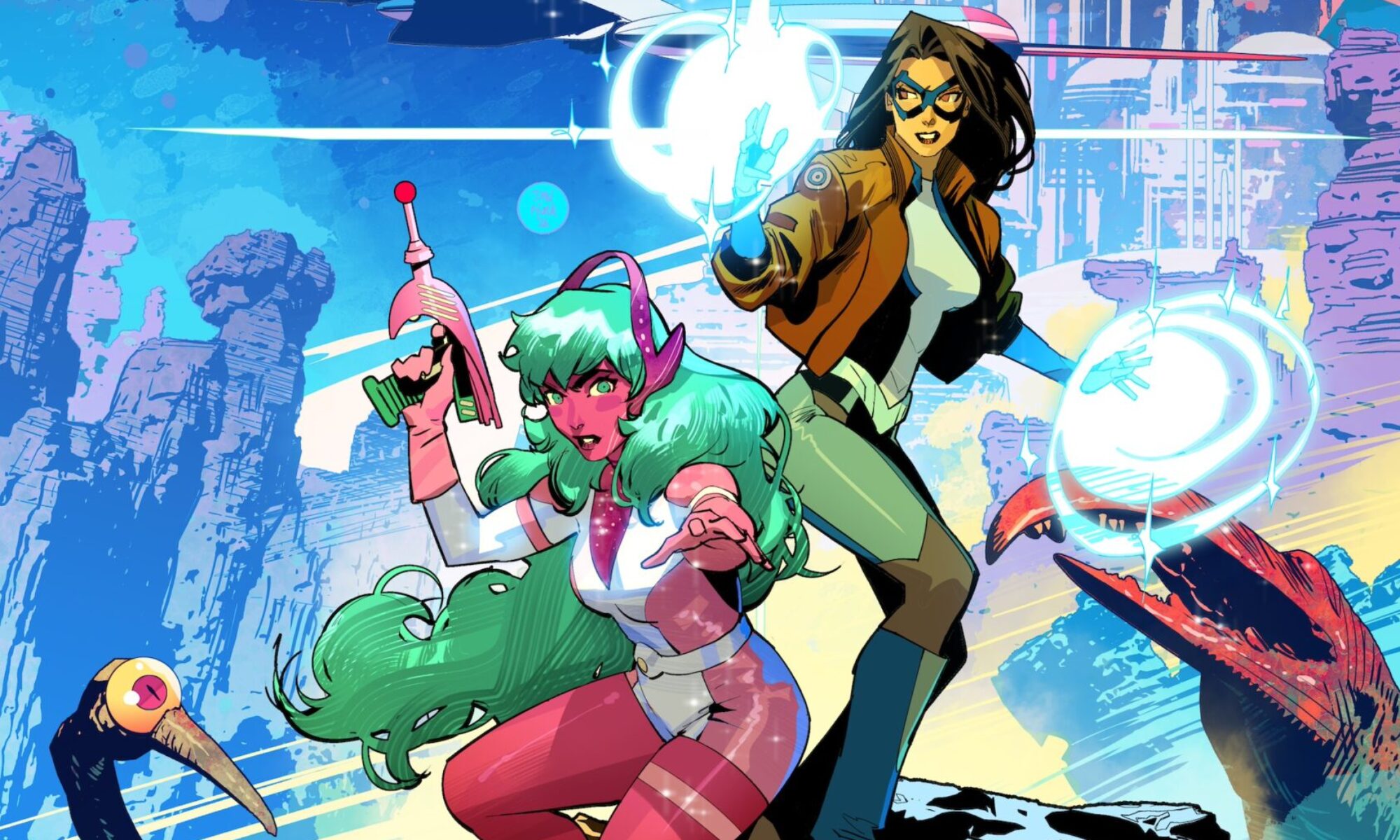
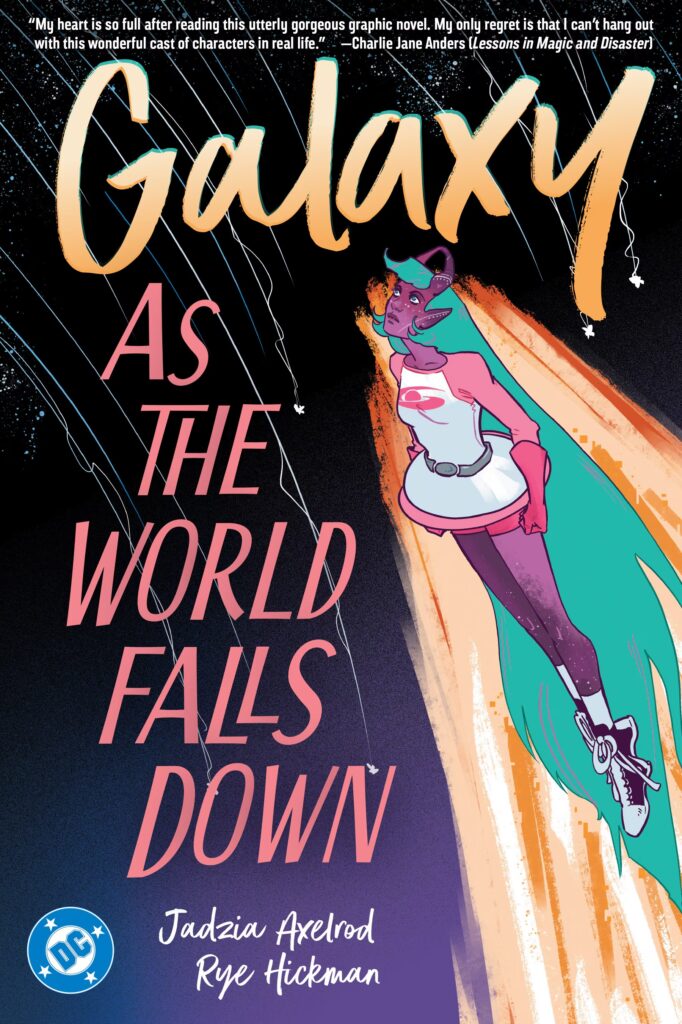
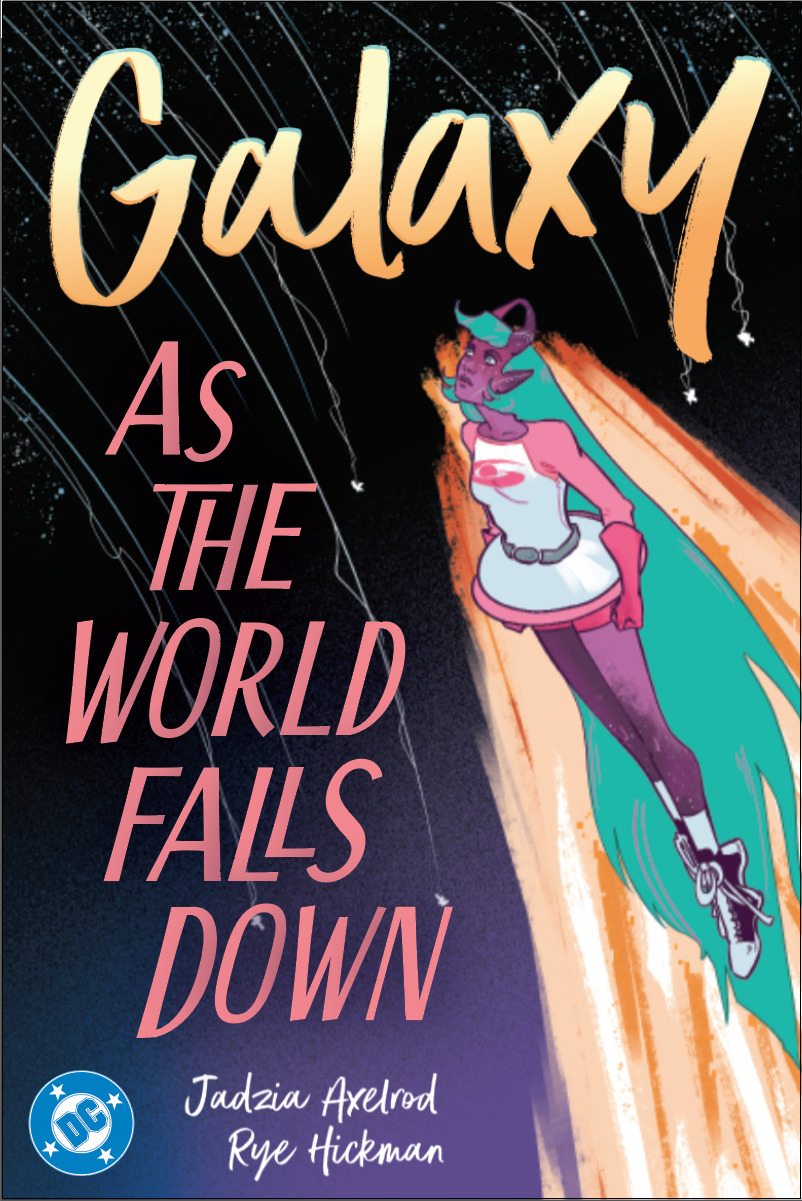
First off, let’s talk about Galaxy: As the World Falls Down. YA graphic novel about teen Galaxy by me, Rye Hickman and Jodie Troutman. This book is simultaneously a sequel to Galaxy: The Prettiest Star (by me, Vash Taylor and Ariana Maher) and also to Bad Dream: A Dreamer Story (by Nicole Maines, Rye, Bex Glendining and Hassan Otsmane-Elhaou). Stars Galaxy, but also has her best pal Dreamer in there as well. Comes out May 5th.
Galaxy: As the World Falls Down is about what comes next after coming out. It’s about being a teenage superhero while also being trans and queer, feeling anxiety about life after high school while making sure the world doesn’t end, and what to do when a powerful empire wants you dead.
That’s amazing on it’s face right? Sure. But! there’s more!
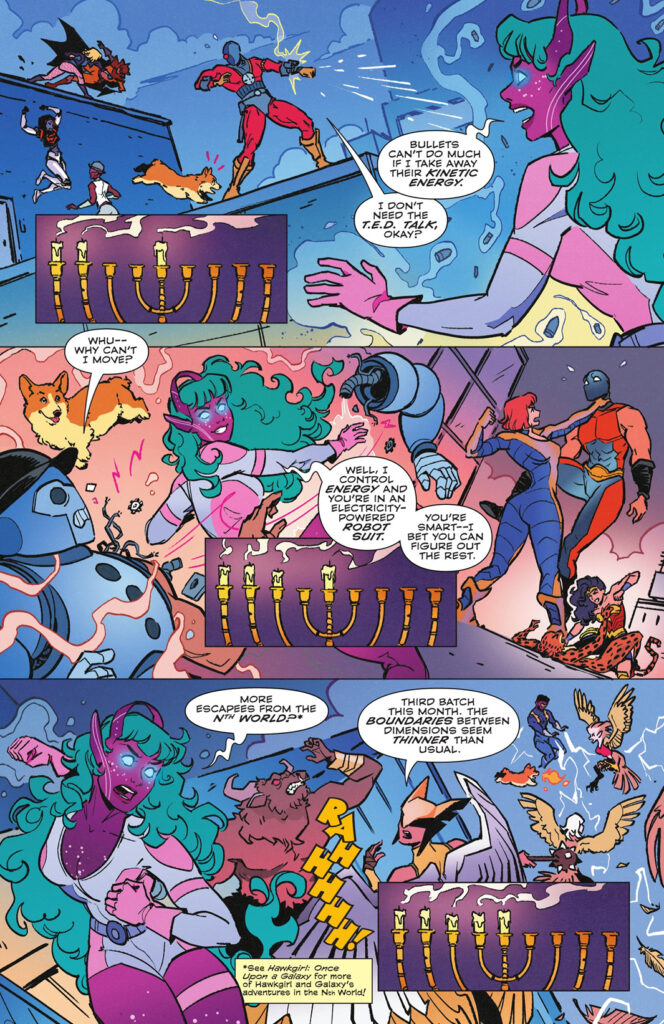
I’m sure you all saw “I’ll Be Home For Hanukkah,” in last year’s DC Holiday Special, I Saw Ma Hunkel Kissing Santa Claus by me, Hannah Templar, Bex Glendining and David Lanham. In it, Galaxy is a part of the Justice League, going on several mission over the eight nights of Hanukkah.
If you read that and thought, “I sure wish we got a full-length Justice League story with Galaxy,” you’re in luck! A week before Galaxy: As The World Falls Down hits stores, Justice League Intergalactic Special drops!
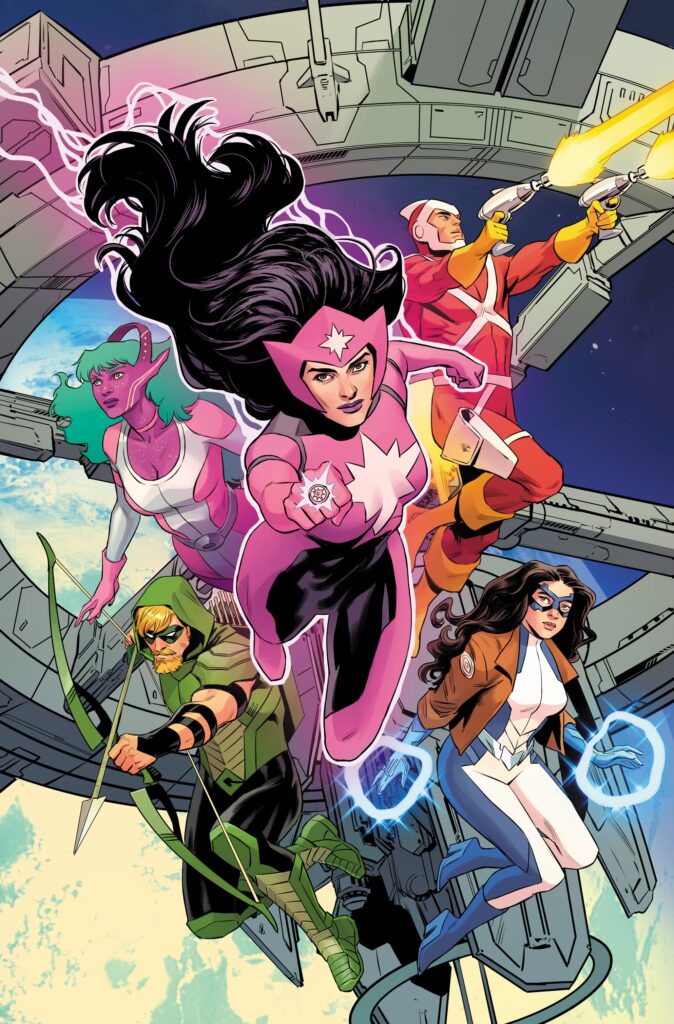
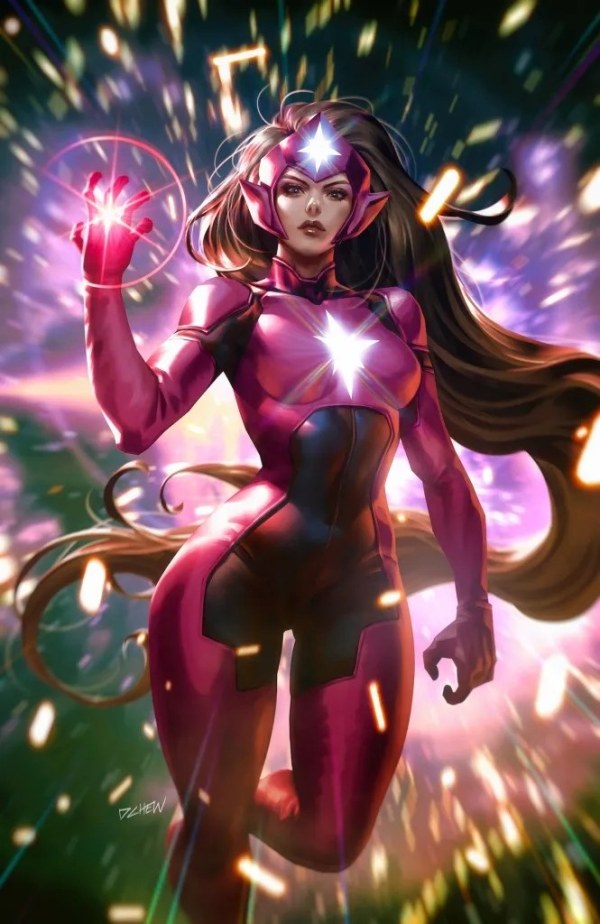
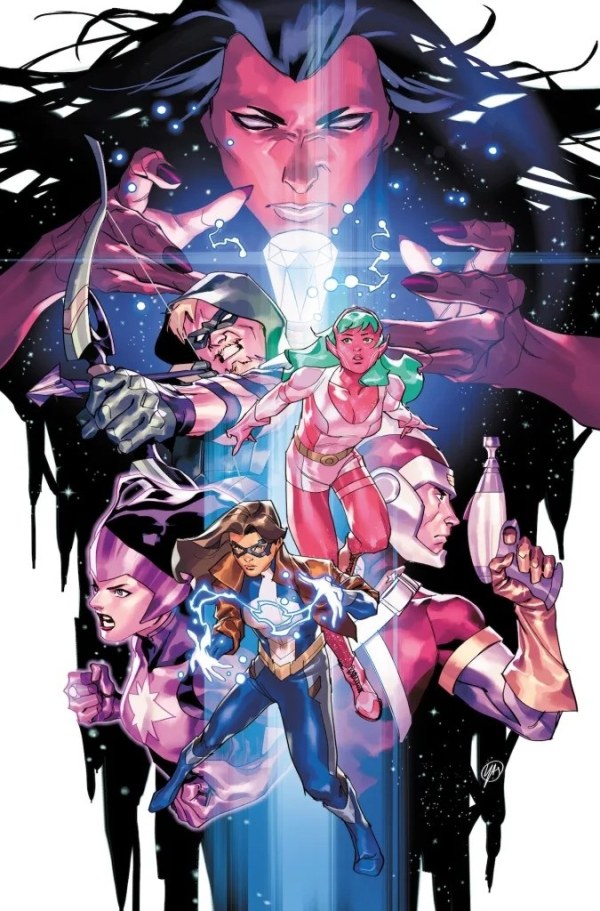
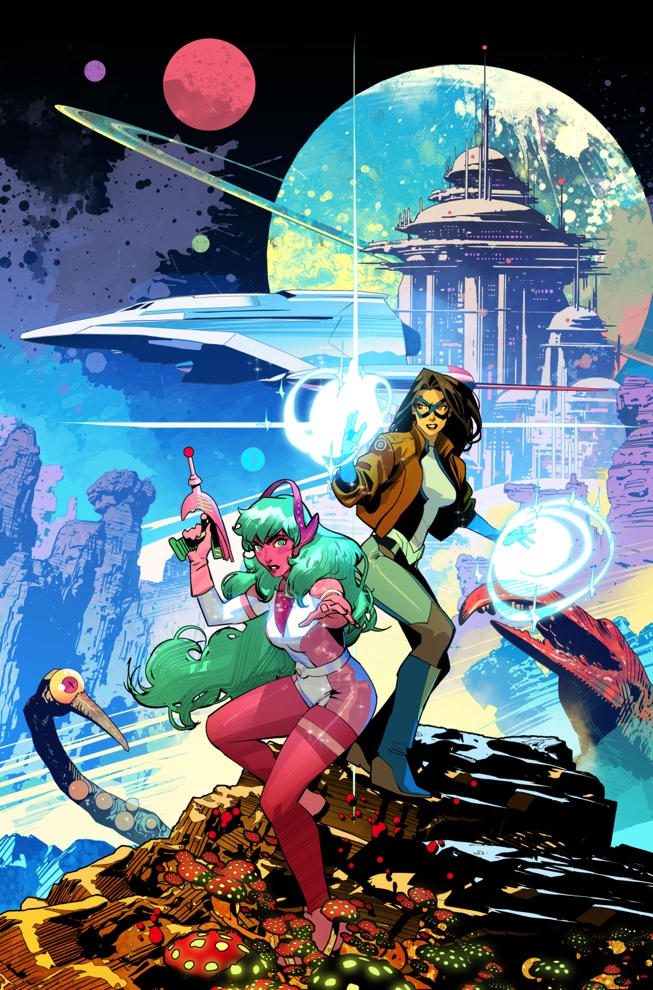
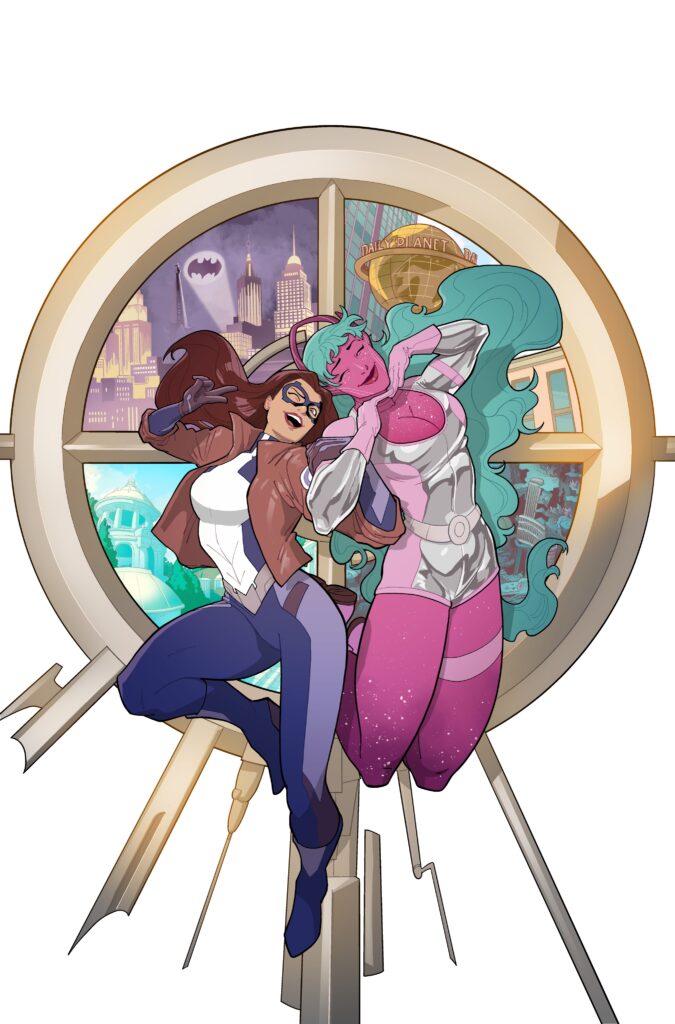
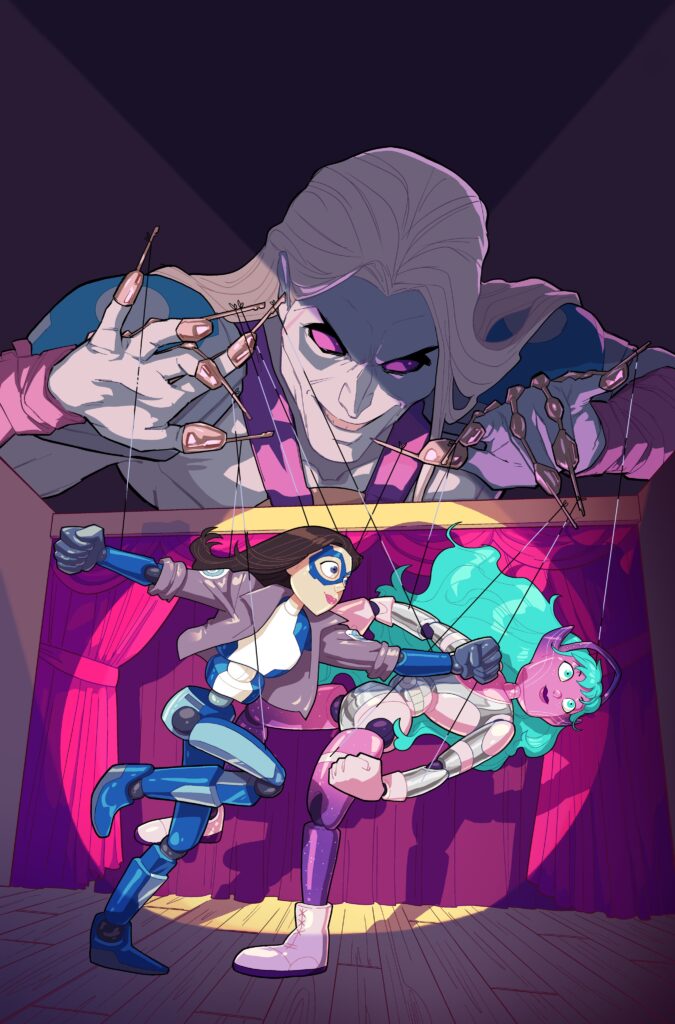
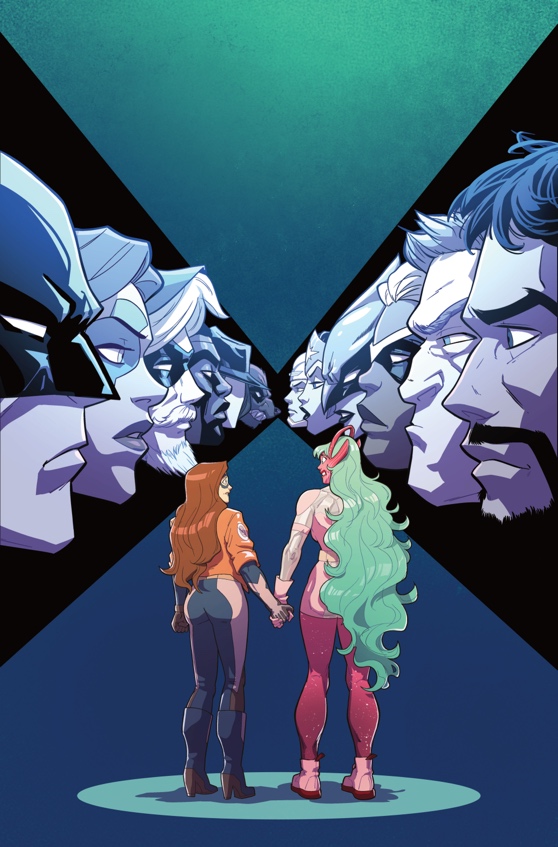
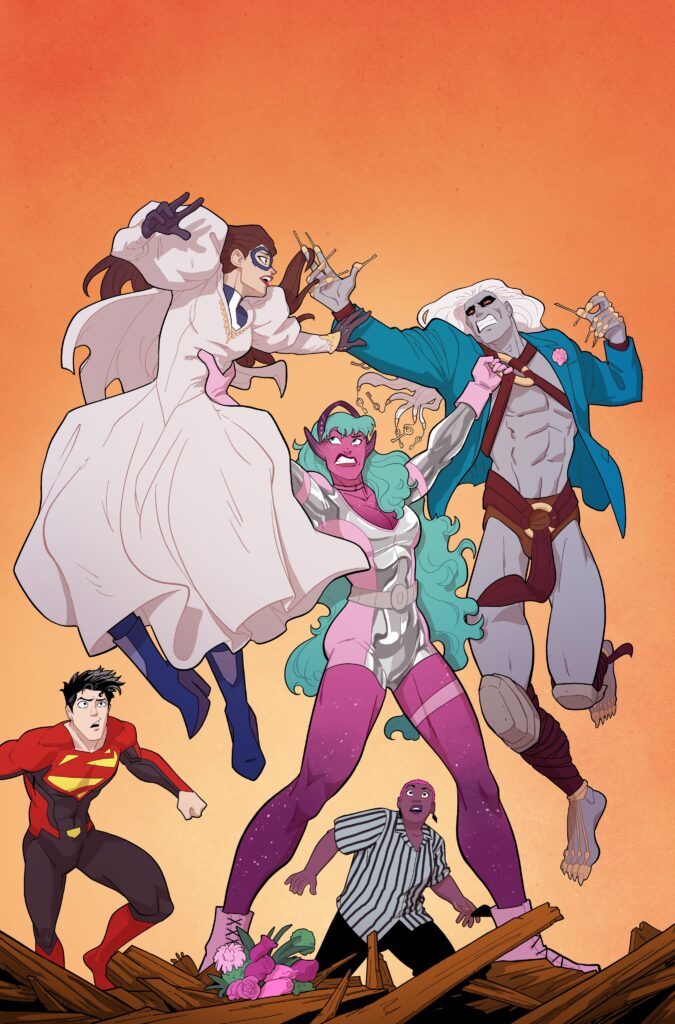
This is a double-sized one-shot in which Galaxy joins Star Sapphire, Adam Strange and Green Arrow on a mission in save the planet Naltor from the Witch Queen. Naltor is the planet Dreamer’s mother is from, so Galaxy tries to bring Dreamer along for the ride. Trouble is, Dreamer’s and Galaxy’s lives have gone in such different directions. Galaxy is a respected member of the Justice League, but her JL teammates see Dreamer as a war criminal. Can their friendship survive their increasingly divergent perspectives? You’d have to be really good friends to weather that. You’d have to be the best friends in the universe.
This incredible, action- and emotion-packed spectacular is co-written by me and Nicole Maines, with Travis Moore and Tamra Bonvillain on art and my old Hawkgirl pal Hassan Otsmane-Elhaou on the letters. Here’s the cover plus three variant covers, because they’re gorgeous:
But that’s not even the news! The news is that Justice League Intergalactic is going to lead into…(drum roll please)…Justice League: Dream Girls — A DC Pride Event!
This four-issue weekly miniseries is also written by me and Nicole, with art done by an absolute murderers row of modern comic talent including Nicola Scott, J. Bone, Brandt&Stein, Stephen Sadowski, Vincent Cecil, Mikel Janín, Rosi Kämpe, and many others. It’s an event book so big we had to get two letterers, Jodie Troutman and Frank Cvetkovic! Here’s the official plot description, from DC:
The story begins in the aftermath of Justice League Intergalactic Special, when Dreamer and Galaxy suddenly awaken on Themyscira, living out an idyllic fantasy as princess and champion of the Amazons. Their confusion deepens when a mysterious stranger washes ashore insisting that Dreamer must leave the paradise she’s always dreamed of to save the world, and the dreamlike landscape around them begins to shift in ways that feel both familiar and deeply wrong.
The threat behind the shifting dreamscape is the Key, a long-standing Justice League adversary whose ability to manipulate perception and hunger for control over dreamspace make him a uniquely dangerous opponent for Dreamer. The world he’s building offers her a version of heroism that feels easier to embrace than the imperfect reality she left behind, and Dreamer fears that those imperfections are all she is…whereas Galaxy, eager to prove herself to the League, believes she can keep her imperfections hidden.
In this series, Dreamer is battling, in many ways, her will to go on. With being a hero, with life at all. She’s nothing like the hero she set out to be, and after everything, she (ironically) can’t see a future for herself. So, she needs her closest friend to remind her, even if Dreamer didn’t exactly ask for her help. As the Key tightens his hold, Galaxy fights her way through the dreamworld to pull her friend back from the brink. Her ability to see through the Key’s illusions makes her a threat he’s desperate to expel. The series blends cosmic action, emotional stakes, and a story about identity, legacy, and the strength of a friendship tested by forces determined to tear it apart.
Check out these awesome Brand&Stein covers for issues 1-4:
Galaxy’s journey has always been about the struggle to define yourself. Each moment of joy and euphoria is paid for by the hard work of claiming your queer and trans identity in a world that would rather you go back in the closet. What Nicole and I did with Dream Girls is place Galaxy and Dreamer in scenarios where that isn’t so: the Key offers them everything they’ve ever wanted, with no effort or difficulty. How does Galaxy handle a life without struggle? Not well, it turns out.
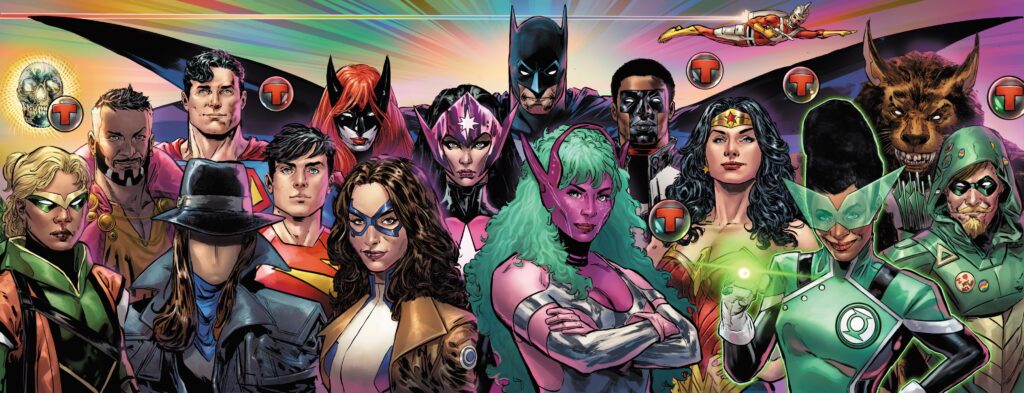
Dream Girls also gets a connected series of variant covers by one of the greatest comic artists of all time, Phil Jimenez, and colored by Arif Prianto:
I get choked up when I look at that image. To see my girl Galaxy front and center with all these iconic heroes drawn by artist I’ve loved since I was a teenager means so much. There was a time when I didn’t think this was possible. That the stories I wanted to tell, about queer and trans people, wouldn’t be accepted in the mainline DC universe, much less as part of their flagship title. But here we are. I’m writing Justice League with a good friend, and a character I made up gets to hang out with Superman and Batman and Wonder Woman and talk about the joys and the difficulties of being trans and kiss her girlfriend and in the pages of the comic its no big deal but it is a big deal in the real world, especially right now.
It’s a dream come true.
Justice League Intergalactic will be in stores 4/29. Galaxy: As the World Falls Down hits 5/5. Justice League: Dream Girls — A DC Pride Event comes out every Wednesday in June. Tell your friends.
Yes, I know I said last week we would talk about THE TWO TOWERS. We will! But I’ve got news this week. And what is this if not a newsletter?
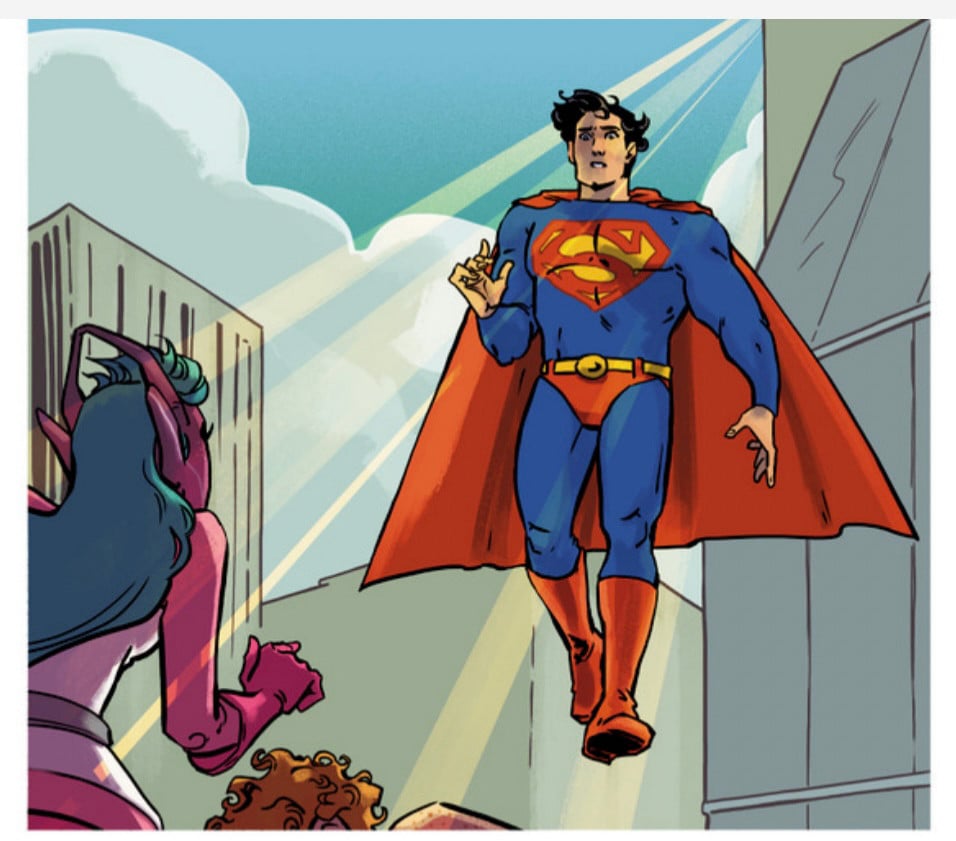
One question I get asked a lot is “When is Galaxy going to meet Superman?” Meeting someone as iconic as Superman, who Galaxy has idolized all her life, would need to be a very special and meaningful story. That story happens to be GALAXY: AS THE WORLD FALLS DOWN by me and Rye Hickman.
It’s a bird, it’s a plane, it’s…
Superman and Galaxy almost crossed paths in HAWKGIRL #1, when they fought the Helioans, but there were a lot of those little guys, so they didn’t get to talk. It’s fun to think about how they had known each other for years at that point. That’s the fun thing about superhero stories—there’s always a secret origin in there somewhere.
Here’s the thing, y’all. Superman plays a big role in GALAXY: AS THE WORLD FALLS DOWN, becoming a mentor figure for teen Galaxy. I got to write Superman for a substantial amount of pages, and while this is obviously Galaxy’s story, I had space to explore what my Superman would be like.
Writing Superman requires you to be 100% earnest. To wink at the reader would be to betray the very concept (though the character himself has winked at the reader in the past, to great effect). So too, would be question his motives. You cannot write a “cool” Superman. But you can write a Superman who’s kindness is effortless. A Superman who’s strength comes not from Kryptonian muscles or a unshakable moral code, but from a willingness to be open.
Superman wears his heart on his bright blue sleeve every single day and that is not a bug, that is a feature.
Superman cast a long shadow over GALAXY: THE PRETTIEST STAR, so its great to finally have that pay off by him showing up larger than life in the sequel! This book is so great, y’all. I’m ridiculously proud of it.
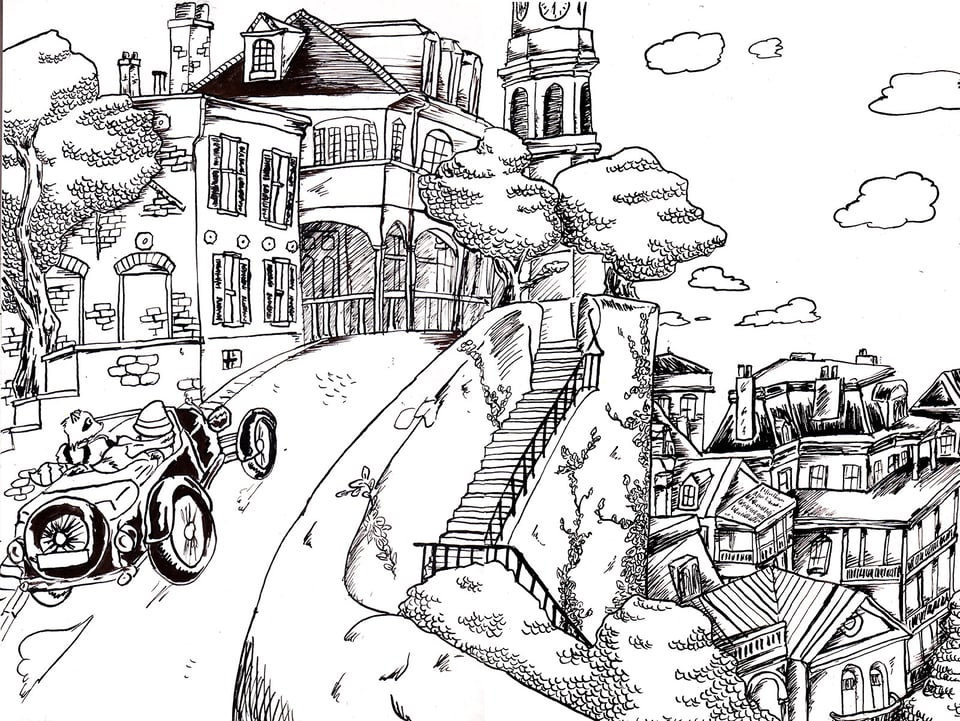
Speaking of things I’m proud of, check out this double-pages spread in SCOESBY CUTS A RUG as Scoesby and Delia leave their rural setting and enter town. The next page, where we meet Scoesby’s family, will be on the Patreon later this week.
Hail and well met, noble traveler. Lets talk about fantasy.
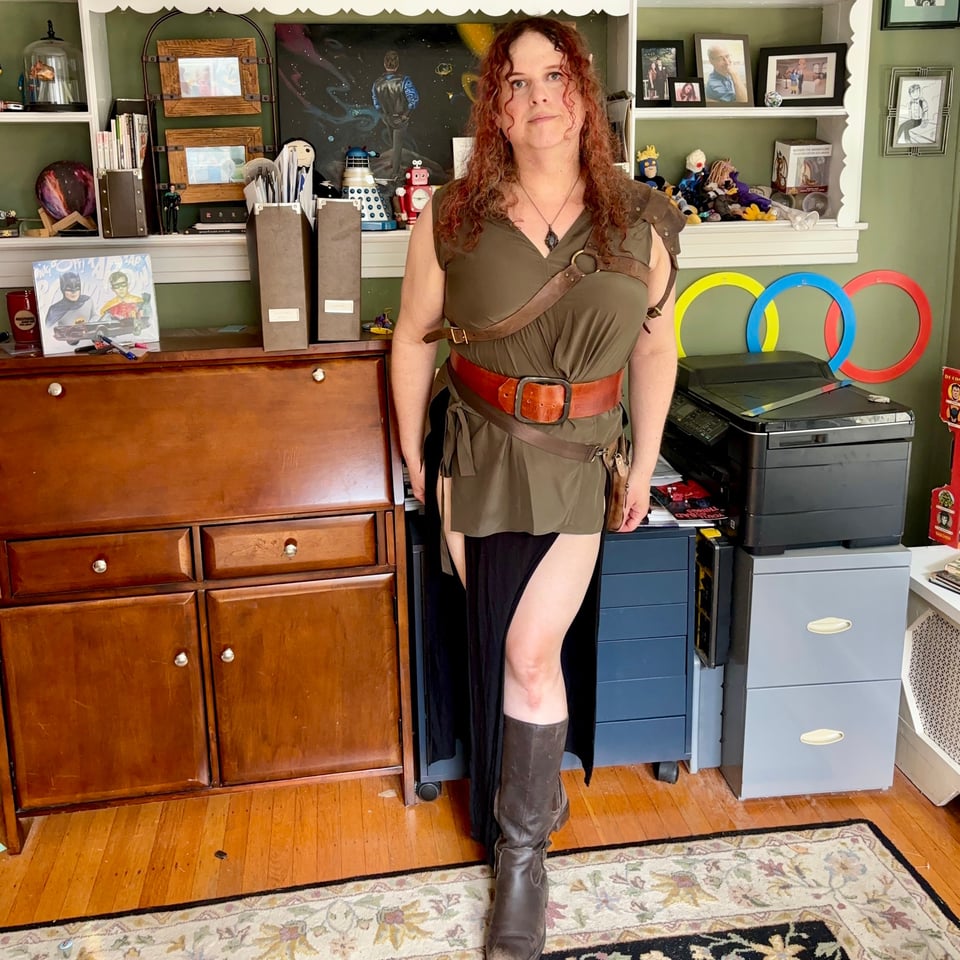
I make a good elf.
Specifically, the fantasy that has defined what fantasy is as a genre for the last 70 years or so.
Back in April, I decided to finally, truly, for real this time, read JRR Tolkien’s THE LORD OF THE RINGS. While it had been difficult to start in past, I decided to go into this book with an open heart and enjoy myself. And I did enjoy myself! I started posting on Bluesky about it. The thread got quite long, and surprisingly popular. But it’s not easy to read long threads on Bluesky, so I thought I put it all here in the newsletter for the month of July; three books, the appendices, and then wrap-up. Let’s journey together, shall we?
Feel free to put on your elf ears, pick up your own copy of THE FELLOWSHIP OF THE RING and follow along:
–
Making my way through LORD OF THE RINGS for the first time and I will admit to being charmed by how Tolkien goes out of his way to explain why the hobbits have tobacco but says nothing about why there’s fireworks but no cannons.
I know Gandalf made the fireworks, but its implied in the laundry list of firework types that these are things many cultures of Middle Earth have, and none of them have decided to turn them into guns. Honestly, I respect it.
–
Tolkien: Nothing is more important than verisimilitude.
Also Tolkien: “It rushed like an express train”
–
Like Bilbo, I too have been specializing in food for many years.
–
Bilbo leaving a busybody cousin who kept sending him letters a wastepaper basket is a level of petty I didn’t think was possible.
–
Frodo being 50 in this is such a wild swing. 17 years go by between chapters and Frodo doesn’t change that much. I’m not certain what it adds… (looks up how old Tolkien was when writing THE LORD OF THE RINGS)…oh, okay. I get it. Carry on.
–
Sam being a weeb for elves is so cute.
–
“I wish it need not have happened in my time,” said Frodo. “So do I,” said Gandalf, “and so do all who live to see such times. But that is not for them to decide. All we have to decide is what to do with the time that is given us.”
BOOM! Mic drop!
–
After listening to Gandalf talk about how important it is for Frodo to leave the Shire immediately for most of Chapter 2, Frodo proceeds to fuck around for two whole weeks. I appreciate the Refusal of the Call as much as the next Hero’s Journeyer, but get it together, Frodo! Back a bag and git!
=
There’s something very deliberate that Tolkien is doing here with time, things that happened long ago affecting the now, the now stretching on and on.
The past didn’t go anywhere. It isn’t even past.
–
People complain about Tolkien’s less than stellar treatment of female characters, but what about Lobelia Sackville-Baggins, the vicious, conniving shrew that everyone hates?
–
Sam may be a weeb for elves, but Frodo can spot a High Elf at fifty paces AND knows their language. Buncha nerds, these hobbits.
–
I love that the stereotype of elves is that they give shitty advice
–
Sam meets some elves and immediately starts acting like a closet case who has just met real live gay people for the first time.
“I don’t know what I want, but I know its ahead of me.”
–
After an arduous journey full of scrapes and difficulties, in fear for their lives from monstrous riders, our heroes find themselves…still in the Shire. At a farm Frodo stole mushrooms from as a child.
The present stretches out endlessly, and the past will catch up with you if you’re not careful.
–
Frodo, despite being a fifty-year-old man, is far and away the most childlike of the four hobbits. The curse of The One Ring is stasis, and I do like the implication that Frodo has been affected by it’s background radiation long before Bilbo handed it over.
–
MERRY: We’ve got the perfect body double for when you’re away. Its the hobbit who’s only character traits are cowardice and an immense appetite. You know, the one we all call “Fatty.”
FRODO: Now, I don’t think…
MERRY: He’s already tried on your clothes and they fit perfectly!
–
MERRY: Remember that time we waged war on the trees?
FRODO: You what?
MERRY: Yeah, they didn’t think much of our hedge. So we chopped ’em up burned ’em all down! (nervous laugh) They don’t like us much any more.
–
Tom Bombadil: God of Theater Kids
–
People complain about Tolkien’s less than stellar treatment of female characters, but what about Goldberry, Tom Bombadil’s sexy lamp?
–
There’s something interesting about Tom Bombadil’s house being so inviting and friendly but also so guaranteed to give the visitors nightmares while they sleep the hosts feel the need to repeatedly warn them about it.
–
Years ago, when I met my first agent in person for the first time, none other than CHRIS CLAREMONT burst into the room to rant about a particular frustrating call with an editor. And when that happened, I realized I was now part of a larger world. That is why Tom Bombadil shows up.
–
I may be Tom Bombapilled.
There’s something charming about our heroes meeting a nature spirit, and having him be a longwinded old stoner. Tom Bombadil is the song the Middle Earth sings, because it is, at its heart, a very silly place.
–
I do like that Tom Bombadil treats The One Ring as a trinket, something amusing for a moment, but nothing more. A man of glacial experience, our Tom.
EVERYONE IN MIDDLE EARTH: The reappearance of The One Ring is the most important thing to ever happen.
TOM BOMBADIL: But for me, it was Tuesday.
–
It must have killed Peter Jackson not to include the Barrow Wights.
–
FRODO: Tom, you’re an omnipotent nature spirit. Will you come with us on our dangerous journey?
TOM BOMBADIL: I’m gonna go home and sleep with my wife.
–
Frodo utterly beefing every single interaction when they get to Bree is so good. He’s a child playing at being an adult away from home for the first time and making all the wrong moves.
–
STRIDER: You need to be less trusting.
FRODO: Who the fuck are you and why you are in our business?
STRIDER: Okay, be a little more trusting than that.
–
The book’s tone changes when Strider joins the party. The adventures up until now would have not been out of place in THE HOBBIT, but now we leave the storybook quality behind and High Fantasy takes over.
Strider carries a broken sword and a mysterious poem! We are lore-dropping all over the place!
–
…but despite Strider’s call for a more adult adventure to start immediately, our heroes are once again delayed. It takes them three hours to leave Bree, and most of that is spent sitting around.
Even Aragorn cannot speed to his future. His present stretches out like everyone else’s.
–
ARAGORN: This is Weathertop. From here you can see the vast expanse of the countryside. Take in the glorious magesty of Middle Earth!
FRODO: (looks around) I want to go home.
–
I don’t know how I feel about Aragorn healing Frodo with an invasive plant. I expect more of you, my guy.
–
Frodo travels through hills Bilbo once traveled through, marked by the ruins of towers built by men ages past who also were corrupted by a great evil.
Time is a flat circle.
–
Stop staying “troll hole,” Tolkien.
–
I know Peter Jackson, Fran Walsh, Philippa Boyens were the ones who put Arwen saving Frodo, but I was still disappointed when Glorfindel showed up.
I’ve read THE SIMARILLION! Glorfindel fights a Balrog and wins! And yet, when he showed up, I was all “Ugh, this guy? Whatever. Wish it was Arwen.”
(yes, it’s the same Glorfindel. I believe if you crack open your copy of THE PEOPLES OF MIDDLE-EARTH, you’ll find an essay where Tolkien says that the Glorfindel in THE SIMARILLIAN is the same guy in LOTR, having been sent back to Middle Earth thousands of years after his death by the Vanar)
–
Frodo is childlike, but he is also brave. And that bravery is not a child’s defiance, but real hero stuff. What’s interesting is that Frodo finds his courage when he needs it the most. But short of assured destruction, he’s callow and fearful.
–
Frodo looks in the mirror and sees himself as both younger and older. The past isn’t past, and the now goes on forever.
–
I’m sorry, but Tolkien knew exactly what he was doing when Sam gently strokes Frodo’s hand and turns away blushing like a schoolgirl with a crush.
–
Pippin is always ready to take the piss out of Gandalf, and for that, he has my respect.
–
People complain about Tolkien’s less than stellar treatment of female characters, but what about Arwen, who does not say one word for the entire length of her introductory scene?
–
But why would you need an impressive Elven princess to say anything when there’s a…(checks notes)…a dwarf to catch you up on what’s happened to the all-male cast of THE HOBBIT? That can’t be right
–
Tolkien’s sudden disinterest in his own elves is so weird.
–
“Time doesn’t seem to pass here. It just is.”
Thanks for underlining a major theme, Bilbo. ‘Preciate you.
–
“Don’t adventures ever have an end? I suppose not.” Bilbo outright stating a major theme once again.
–
I like how the Council of Elrond is just people saying “Someone else should do something” in variety of different ways.
–
“I am but the heir of Isildur, not Isildur himself.” Aragorn has seen too much to believe that time is a flat circle. This battle cannot be won by one man with one sword who got a lucky shot in.
–
ELROND: Bilbo, tell this council how you found the Ring.
BILBO: Can we break for lunch first?
ELROND: Absolutely not.
–
GALDOR: Why isn’t Saruman here?
GANDALF: (deep sigh) You would not believe how long Saruman has been a piece of shit.
–
ELROND: You met Tom Bombadil, Frodo? Aw, shit, that’s my boy!
–
ERESTOR: Would Tom Bombadil not take the ring, and keep it forever harmless?
GANDALF: Trust that stoner to keep track of something? Seriously?
–
Again, Frodo’s courage exists only when all other options are exhausted. He volunteers to take the ring only because no one else will.
Everyone sits in silence, waiting for someone else to speak up. And since no one does, Frodo has to.
I mean, Bilbo volunteers, but everyone says “You aren’t going to survive the week let alone a trip to Mordor, and you could barely get rid of it the first time,” so that hardly counts.
–
Despite Gandalf’s insistence on urgency, Frodo has to wait two months before the Fellowship is chosen and then another week before he can leave. But he gets Bilbo’s Sting. Isildur’s sword is reforged and placed in Aragorn’s scabbard.
The future is difficult to reach, and we carry the past with us.
–
Elrond and Gimli’s fight to have the last word ended far too soon.
–
People complain about Tolkien’s less than stellar treatment of female characters, but what about Arwen, who does not say one word for the entire length of Frodo’s time at Rivendell?
–
GANDALF: This looks like a nice cheery place to set up camp.
LEGOLAS: I hear the stones lamenting the loss of people long past. They mourn for the elves who have gone.
GANDALF: We’re still setting up camp here.
–
Aragorn seriously pulling a “It’s quiet…a little too quiet.”
–
Oh, I see how it is, Aragorn. When its birds in league with the Dark Lord, THEN you care about invasive species.
–
GANDALF: The path you chose is fucked, Aragorn.
ARAGORN: This whole journey is fucked. So keep your opinions to yourself.
–
This part is so great. Our heroes are beaten down not by monsters or an army, but by weather and weariness.
Sauron may have sent the snow storm, but they were still planning climb over mountains. This journey is breaking them down, and it’s only just begun.
–
GANDALF: Here is Moria, an ancient Dwarven and Elven stronghold. I know everything about it.
BOROMIR: What’s the password to get inside, then?
GANDALF: …everything but that.
–
We’re repeatedly seeing the limits of Gandalf’s power. He gets cold feet in the snow like anyone else (save Legolas). It takes Merry’s offhand comment to spark the answer of Moria’s locked door.
He literally and figuratively cannot make fire without kindling.
–
SAM: How could dwarves live in such darkness?
GIMLI: …
SAM: What?
GIMLI: We know how lamps work, Sam.
–
GIMLI: Just for that, I’m going to sing a song.
–
They have a cave troll.
–
This is this first time we see orcs, and a “tall” orc chieftain is described as “almost man-high.”
I’m so used to seeing orcs portrayed as giants that Tolkien having them top out at around 5’6″ is giving me the giggles.
–
Gandalf, a representative of an age long past, is claimed by a monster as old–if not older–than he is, an ancient mine entombing them both.
The Fellowship has lost their most vocal connection to the past. Now they only have the present.
–
ARAGORN: (holding up healing herbs) They are dry and some of their virtue is gone.
ME: Yeah, me too.
–
ARAGORN: Let’s go through Lothlórien.
BOROMIR: You mean the forest no one comes out of?
ARAGORN: Yeah, that’s the one.
BOROMIR: Can we not just have a normal road?!?
ARAGORN: There’s not really a normal road to Mount Doom, bro.
–
Everyone loves Lothlórien elves, the lovely elves that live in the trees! (5 pages later) We regret to inform you the elves are racist.
–
Lothlórien is locked in time, still clinging to the old ways–and old prejudices–of centuries ago. The past didn’t go anywhere. It isn’t even past.
Sam, who spent 3 months in Rivendell: “This is more elvish than anything I’ve ever heard tell of.”
–
CELEBORN: Sorry about the racism. That was messed up. My bad.
–
So, Galadriel is tall, beautiful and speaks in a low voice? We love a trans queen.
–
SAM: Sure wish we could see some elf magic. You’d think Galadriel would know some.
GALADRIEL: (suddenly behind Sam) Heard you were talking shit.
–
FRODO: You’re wise. You take the Ring.
GALADRIEL: lol lmao
–
Interesting that here, Frodo’s childlike nature is positioned not as a weakness but a strength. Galadriel desire to do great things would ultimately be corrupted, but Frodo doesn’t have that ego. He just wants to live in the Shire and throw an extravagant birthday party every year.
–
Galadriel chides Frodo for not exploring the Ring’s full potential, something he never even tried once despite owning it for 17 years. The One Ring is thwarted by Frodo’s utter and complete lack of curiosity.
Bilbo wanted to left alone, so the Ring made him invisible. Frodo wants a house with a garden and Sam, which he already had. What can a magical ring possibly offer him?
–
People complain about Tolkien’s less than stellar treatment of female characters, but what about Galadriel, whose main character traits are reading your mind without permission and being aloof?
–
Giving the elves exposition is ingenious, because its quite clear they think non-elves can’t find their own buttholes to fart without assistance.
–
CELEBORN: …there you will find Nindalf, or “Wet Wang” as it is known in your tongue.
ME: (stifles a giggle)
–
GALADRIEL: And what gift would you like?
GIMILI: Can I be real creepy for a minute?
GALADRIEL: Sure thing. Cool if slip a racial insult in my response?
–
The dynamic of Boromir really wanting to be in charge but no one listening to him and everyone looking to Aragorn who doesn’t know what to do is pretty great.
–
I can’t stop thinking about the gifts Galadriel gave the Fellowship. It starts out well with a jewel-encrusted scabbard and the greatest bow and arrows ever made. But then it’s 3 hairs, a box of dirt and a glass of water.
–
In boats provided by the elves, without Gandalf to lead them and Aragorn’s reluctance to make decisions, the Fellowship is literally and figuratively adrift.
–
The time spent in Lothlórien, full of ancient elves steeped in history, has sped by—Sam thought it was three days, but it turns out they spent a month there. Even on mission of world-threatening urgency, our heroes are delayed.
The past isn’t past, and the future is difficult to reach.
–
Awww, Boromir is concerned about his companions’ short little legs!
–
Okay, so. The Gates of Argonath. The Pillars of Kings. The colossi of Isildur and Anárion.
It goes without saying that these enormous monuments represent the mutability of time and how the past is still present, right? We get that. That’s a major theme of this book.
But also! They represent something we’ve heard hinted at but not really confronted directly: a lost Golden Age. Not only under the rule of these kings, but also the era of when these massive statues were designed & carved. Things were clearly better in the past, or these stone dudes wouldn’t exist.
These statues have an effect on Aragorn. Not just seeing them, but passing through them into what was once Gondor brings a sparkle to his eye and spring to his step. Aragorn–not Isildur himself, but the closest we’ve got–is invigorated by the physical closeness of his homeland.
While Frodo, Sam, Pippen and Merry are going farther from the land of their heritage, Aragorn is going BACK. Frodo’s challenge is to leave, but Aragorn’s is to return.
This Golden Age was one of borders and hostility. The statues of Isildur and Anárion hold axes in one hand and lift the other in a warning to outsiders. This is a show of wealth and strength, poised as a threat.
Percy Bysshe Shelley’s Ozymandias wishes.
Everything was better, but it was also worse. Everything was great, but it also fell. These battles were fought before, but they must now be fought in a different way.
For all the glories of the past, all that remains is the darkness it could never quite extinguish.
–
Boromir wants Frodo to trust in the walls of Gondor. But Frodo, who has just seen the Gates of Argonath, knows that Boromir’s promise of martial protection will not be enough. If it wasn’t enough during the Golden Age, it certainly won’t be now.
–
Here, finally, is the payoff for hundreds of pages of delays and dalliances: Frodo realizes they are out of time.
–
BOROMIR: What have I said? What have I done?
GALADRIEL: (miles away in Lothlórien, suddenly noticing something no one else can see) Looks like someone didn’t pass the test.
–
Frodo sits at the Seat of Amon Hen, the “Seat of Seeing,” and beholds a vision of the very thing he had tried so hard to ignore back at the Shire: the outside world. And to his horror, the outside world looks back.
–
Frodo chooses to brave and head to Mount Doom alone for the same reason he always chooses to be brave: there is no one else.
–
Sam figures out what Frodo’s up to before everyone else (of course) and gets Frodo’s attention the only way guaranteed to work: nearly drowning the river.
–
Then Frodo and Sam confess their undying love for each other. Okay, they don’t. But also, they don’t not, if you catch my meaning.
–
People complain about Tolkien’s less than stellar treatment of female characters, but what about Arwen, who does not say one word for the entire length of THE FELLOWSHIP OF THE RING?
–
And that’s it for THE FELLOWSHIP OF THE RING! I enjoyed it much more than I thought I was going to. Thanks for coming along with me on this. Next week we’ll get into THE TWO TOWERS.
The news is out, finally! GALAXY: THE PRETTIEST STAR is getting a sequel, GALAXY: AS THE WORLD FALLS DOWN! The adventures of teen Galaxy (as opposed to the early-twenties Galaxy in HAWKGIRL) will continue in 5/5/26, by me and the spectacular Rye Hickman!
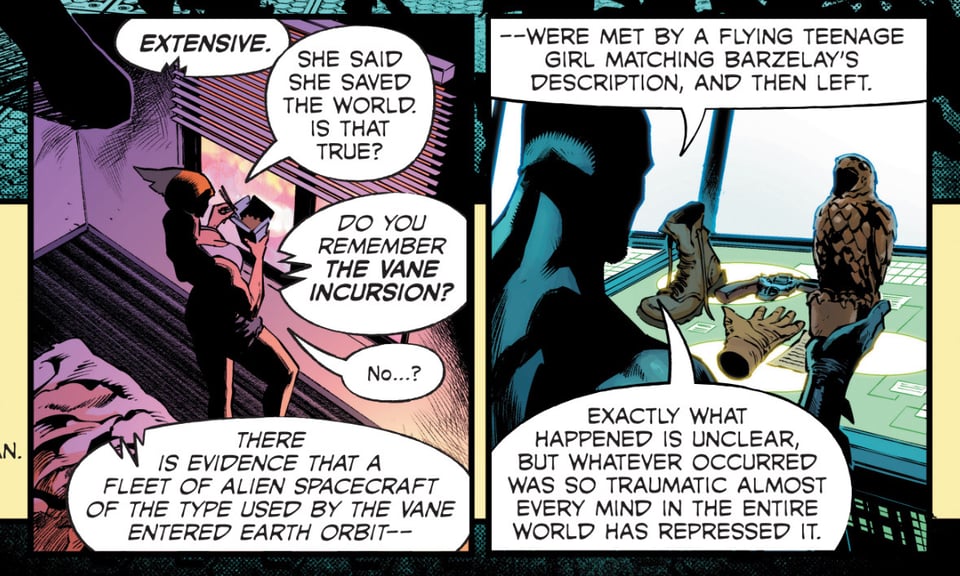
Can’t go too much into the juicy details about what happens to our girl Taylor Barzelay in this volume—somethings are better let to be discovered. But those who have read HAWKGIRL: ONCE UPON A GALAXY may have a clue…
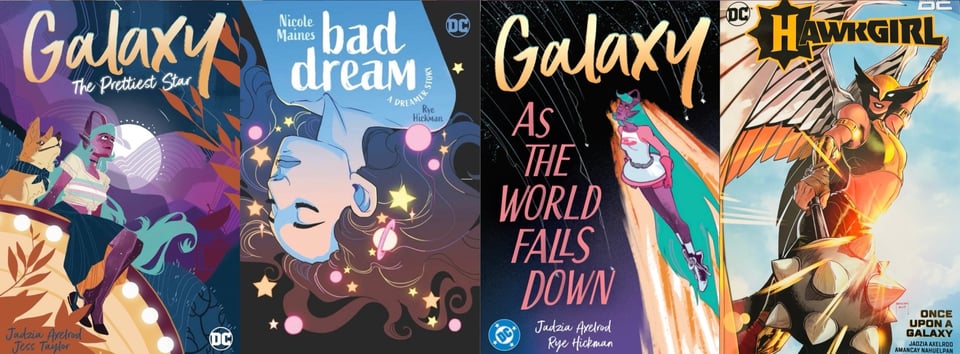
For those wondering where this book fits in Galaxy continuity, here’s the chronological order:
GALAXY: AS THE WORLD FALLS DOWN takes place at of the end of the same summer in BAD DREAM: A DREAMER STORY which is another reason why its so great to have Rye drawing it!
I am so proud of this book, y’all. Rye is firing on all cylinders and I think its the best thing I’ve ever written.
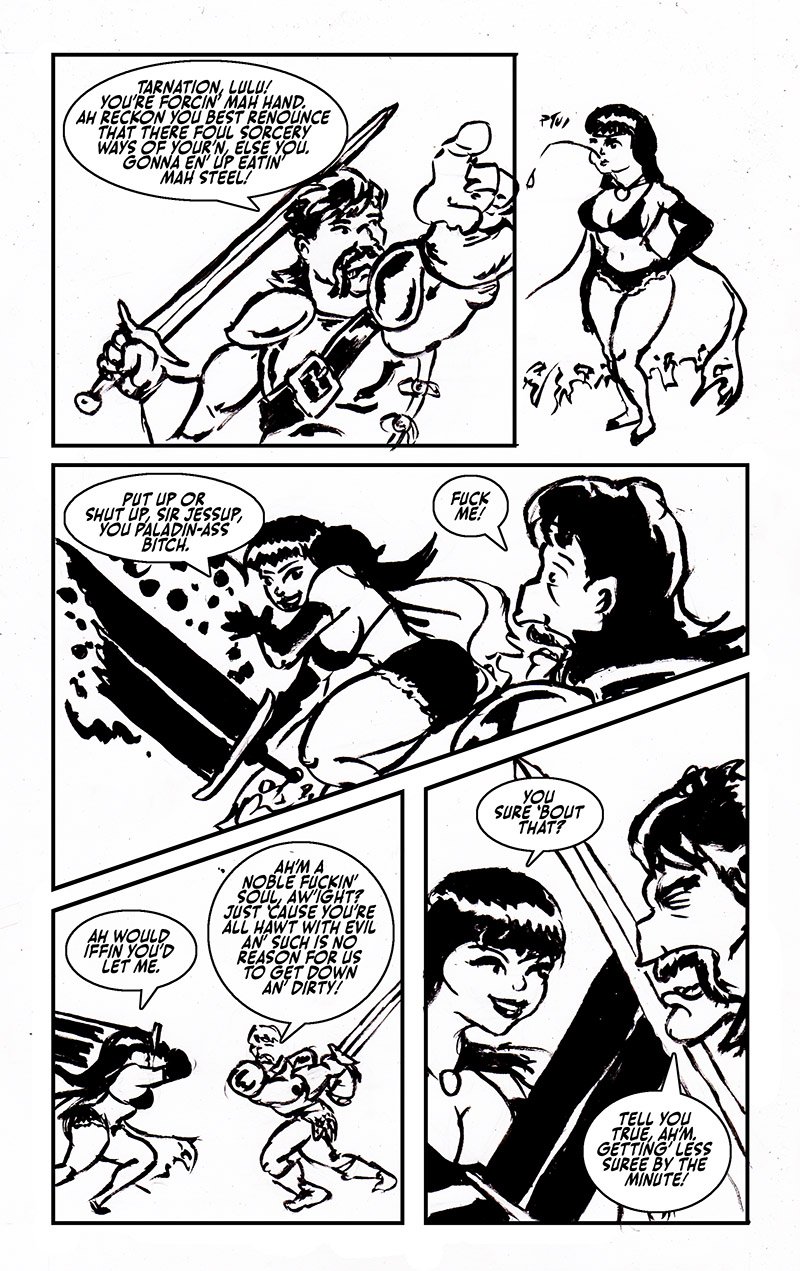
Now that we’ve talked about wonderful comics, let’s talk about terrible comics. Terrible Comics Day, the creation of Pseudonym Jones, is an invitation to let go of one’s inner critic and embrace, for one day, being terrible. And so I have:
I’ve been playing around with the idea of “Hillbilly Knights,” since I finished reading THE LORD OF THE RINGS (more on that next newsletter) and Terrible Comic Day gave me the opportunity to play around. The comic turned out terrible, and I love it!
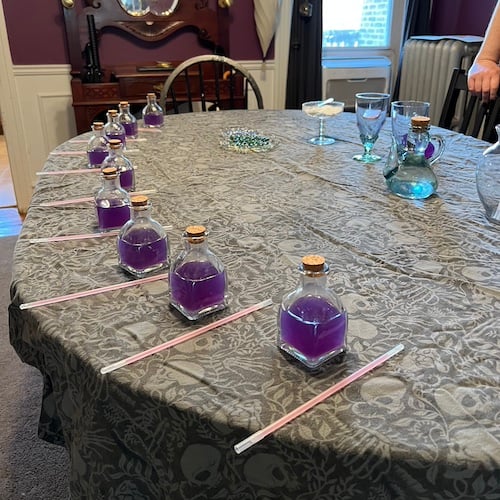
My child, Wednesday, had yet another birthday, and wished it to have a mystical, magical theme. As my wife and I both believers in anything worth doing is worth over-doing, one of the activities was a “potions class.” Each child was given a bottle with a potion base (red cabbage juice with glitter) and a magic stirrer (glow stick). Once every one had activated their magic stirrer, I describe their two options, a flight potion or and underwater breathing potion. The kids chose either a dragon or a mermaid scale (flat glass marbles, used in flower arranging), and then I showed them the main ingredients. A clear liquid (vinegar) was added to a goblet of potion base for flight, turning it pink. A white powder (baking soda) was added to another goblet of potion base, turning it blue. Each kid then added their chosen ingredients, and watched wide-eyed as the liquid in their bottles in their hands changed color.
This turned out to be the perfect level of activity for this age group. Just enough personal choices to feel the hand a hand in things, but not too much to be overwhelming. Nothing was toxic, so I didn’t worry about them handling any of the ingredients, but none of it smelled particularly appetizing, so no one tried to drink them. Everyone got actually do something, and watch their choices have an effect right in front of them. And they got something cool to take home.
It was, in a word, magical.
Each and every red cabbage leaf contain a chemical called anthocyanin, which works as indicator for acidity. Adding acid like vinegar turns it pink, while adding a base turns it blue. Even explaining the science didn’t dilute the joy, because a real transformation still happened in front of them. We weren’t mixing paint, we were mixing chemicals. The wonder was still intact. You could see it in every child’s eyes.
Cabbage. Vinegar. Baking soda. Bottles and bits of glass from the craft store. Glitter. Glowsticks. Humble ingredients. But maybe that’s where all magic comes from.
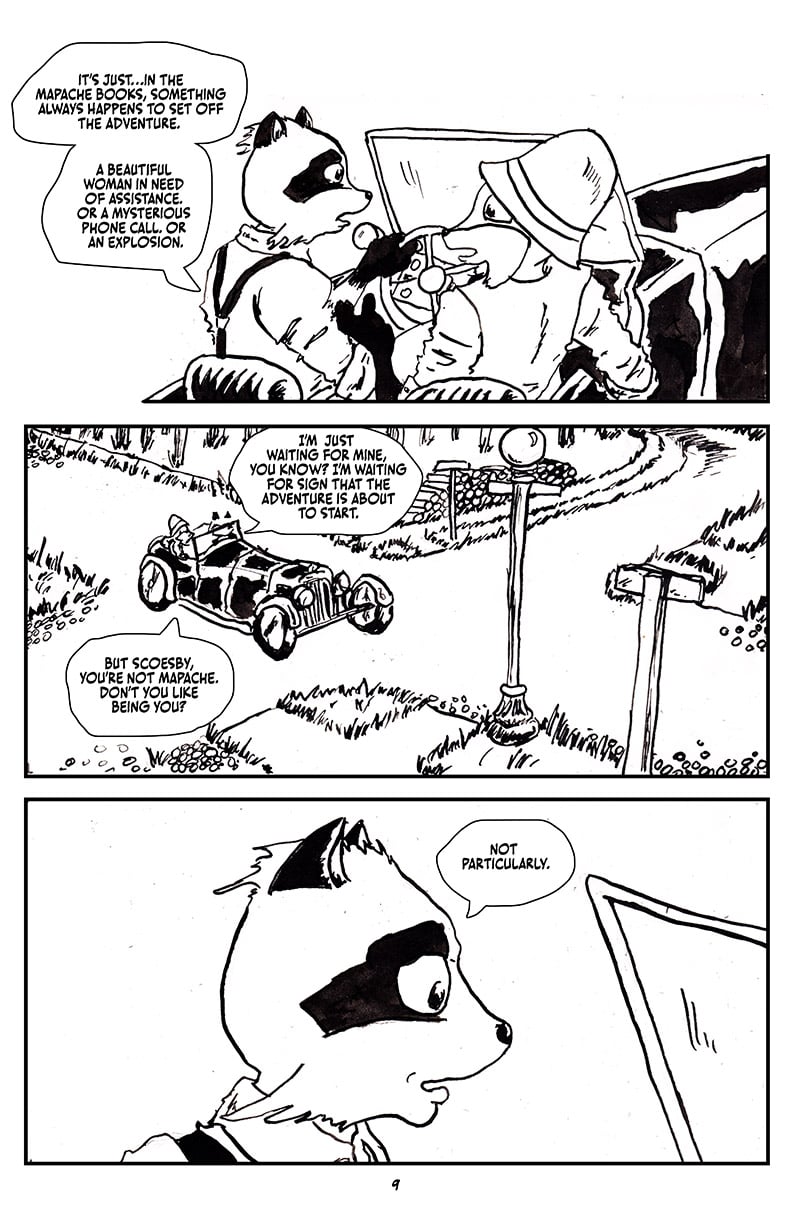
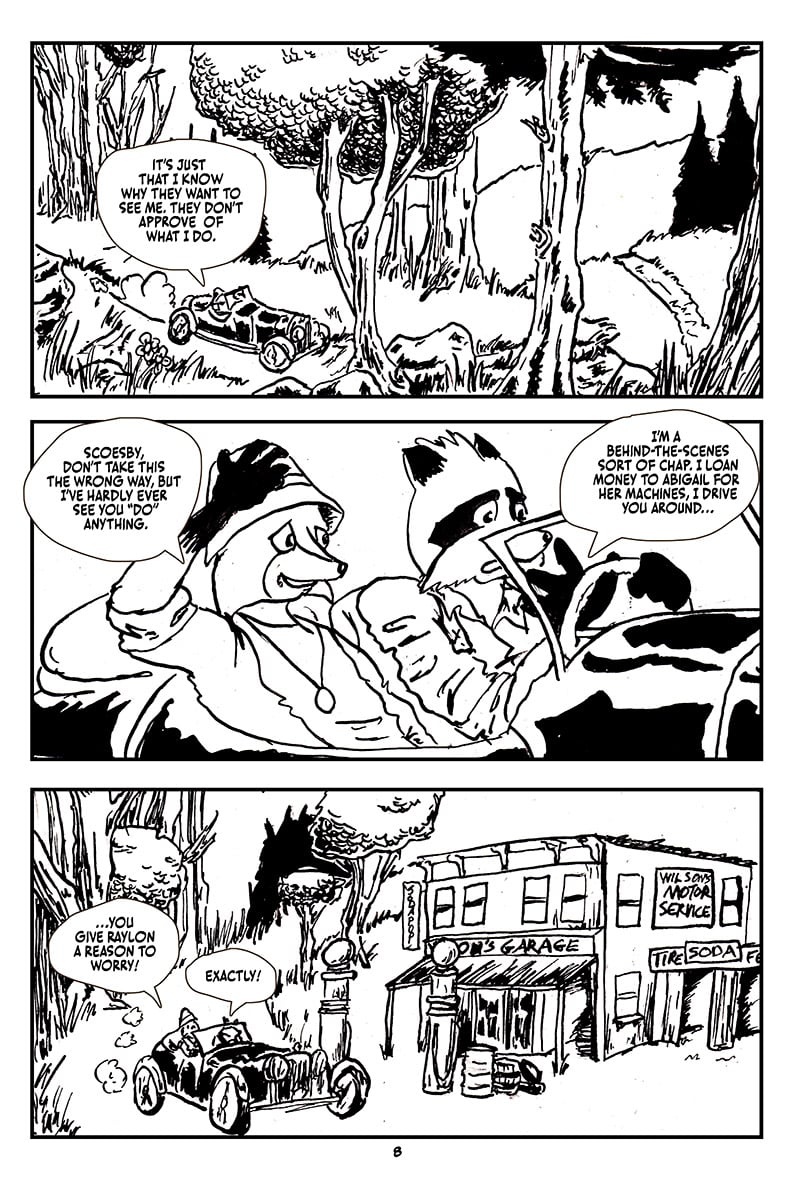
This weeks’s page of Scoesby Cuts a Rug contains no magic. Unless you consider a raccoon and fox driving through the woods, as some people might, or if you find comics as a medium as magical, which I do. The next page is already on the Patreon.
That’s right folks, I will be reading selections from Galaxy: The Prettiest Star, Hawkgirl: Once Upon A Galaxy and other work tonight at Exclamation Point!, Philly’s Comix Reading Night. You know it’s true, because they put it on the flyer:
Come on over! You can finally learn the right way to pronounce “Cyandii” (it rhymes with “free candy”).
Fridays on the ol’ Bluesky, I open up the account to random questions. One such question gave me pause. Anonymously, someone asked me “How do you continue to move forward in your transition in such a scary timeline? I need to keep going myself but I’m so so scared.”
Here was my response, just in case you reading this had concerns along the same lines:
It has always been scary to be a trans person. We had a few years where it was easier—though not for everyone—but even then, we were just safer, not safe. It is it very scary now, but it is less scary than it was 20 years ago or 200 years ago.
We have always existed in scary times. We have always existed because we have a strength that comes from self determination. We know who we are. We had to buy that knowledge with pain and loss and grief, but we paid it and we keep paying it, each and every one of us. Because it’s worth it.
YOU are strong. I know you are strong because to took the first step. So many people don’t. You can continue on this journey because you’ve already done the hardest part. That took bravery, that took strength, that a level of compassion for yourself that you cannot lose now.
Your life will not be easier if you stop your transition. You may make your life easier for others. But that is not the same thing as it being easy for you, despite what some cis people would like us to believe. You have to be kind to yourself, and give yourself the life you know you deserve.
I wish I could tell you it gets easier, but there’s no guarantee of that. What I can guarantee is that if you stop now, if you deny who you are, you will regret it for the for rest of your life.
You and I have tasted the fruit of the Tree of Knowledge. We know who we are. And that fruit is inside of us now. It won’t go away just because it was hard to swallow. We can let it rot and fester within us, or we can allow it to take root and blossom through our bodies and lives.
I keep going forward because I can’t go back.
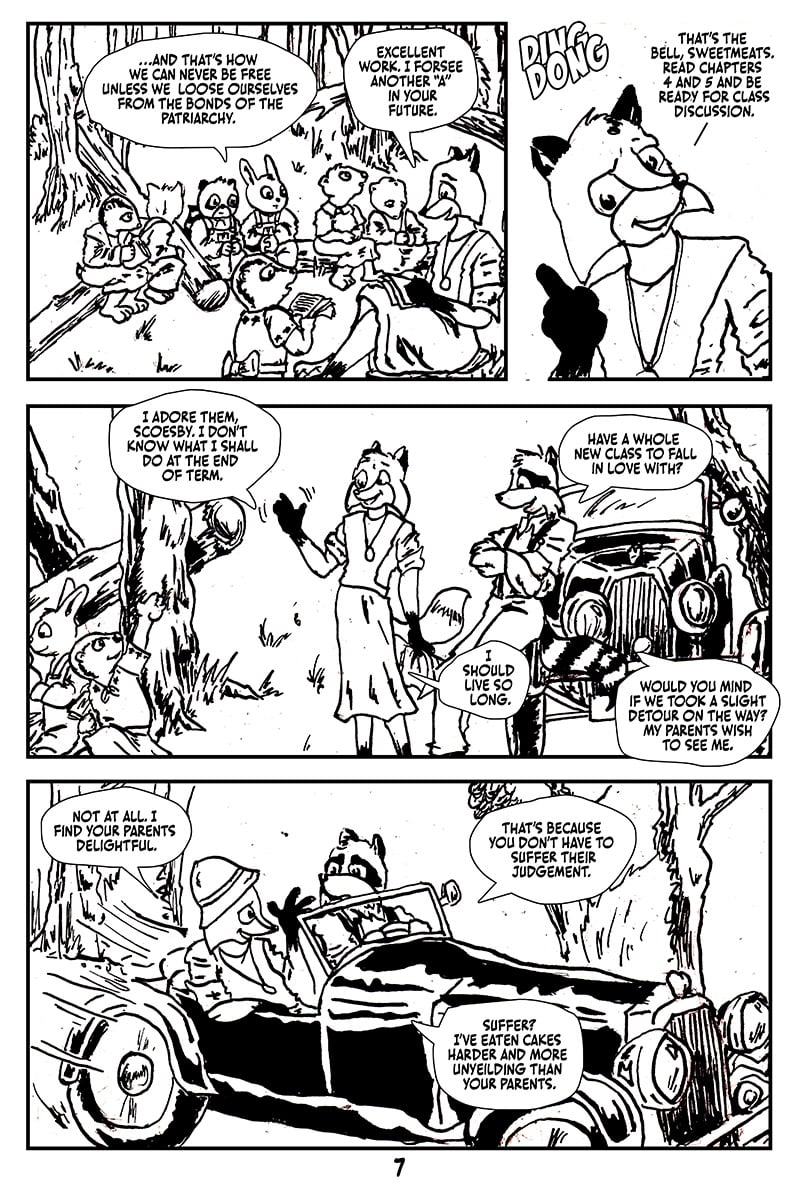
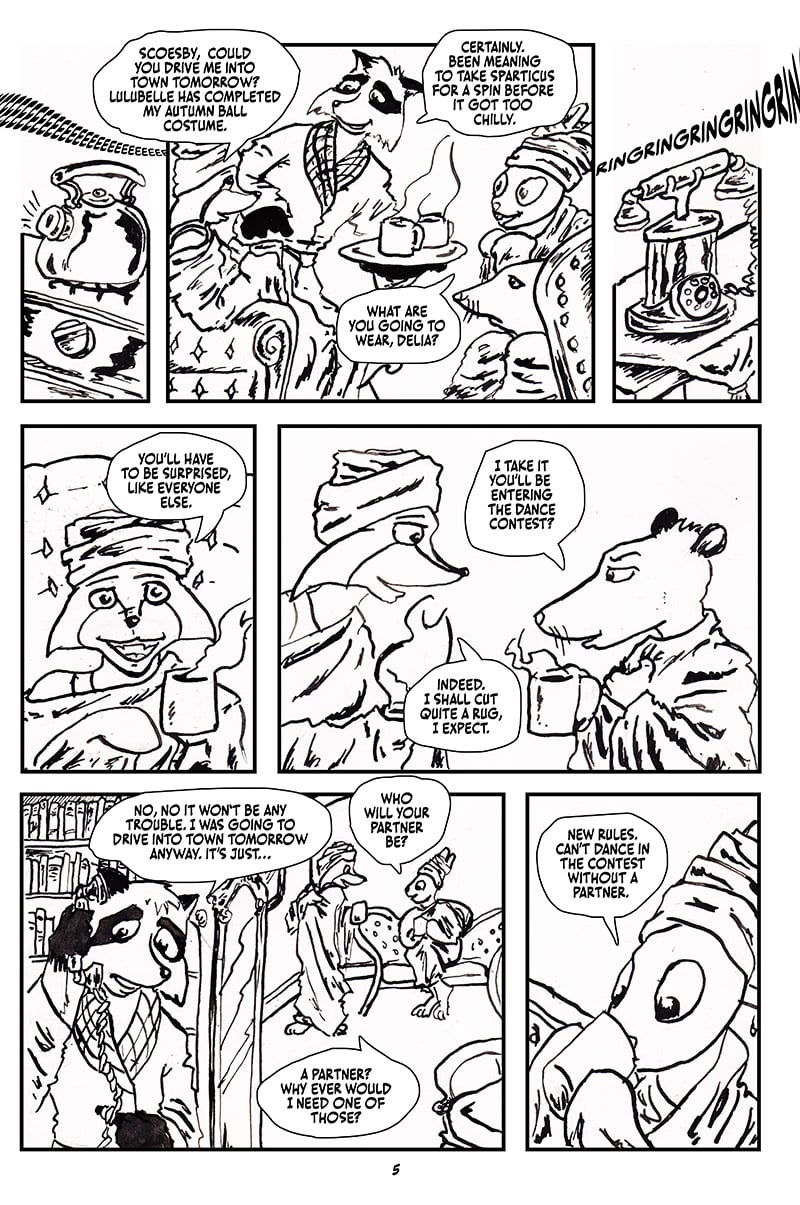
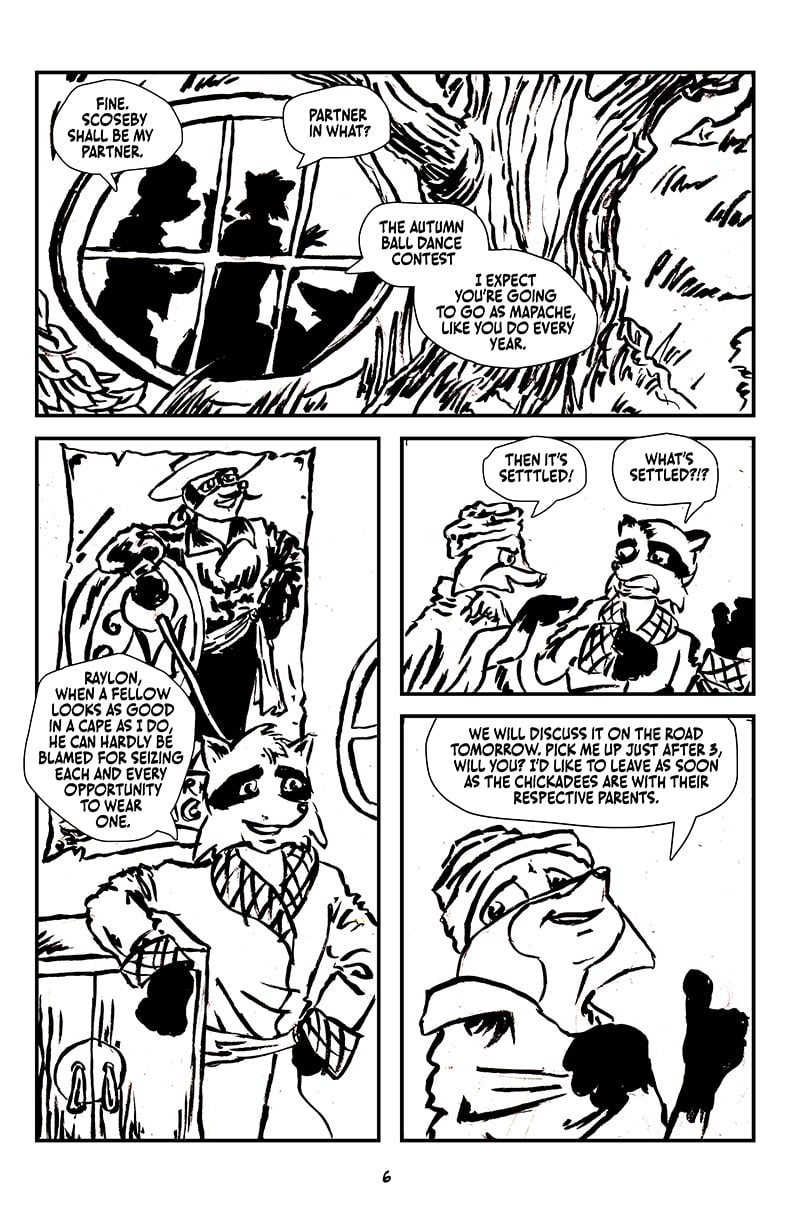
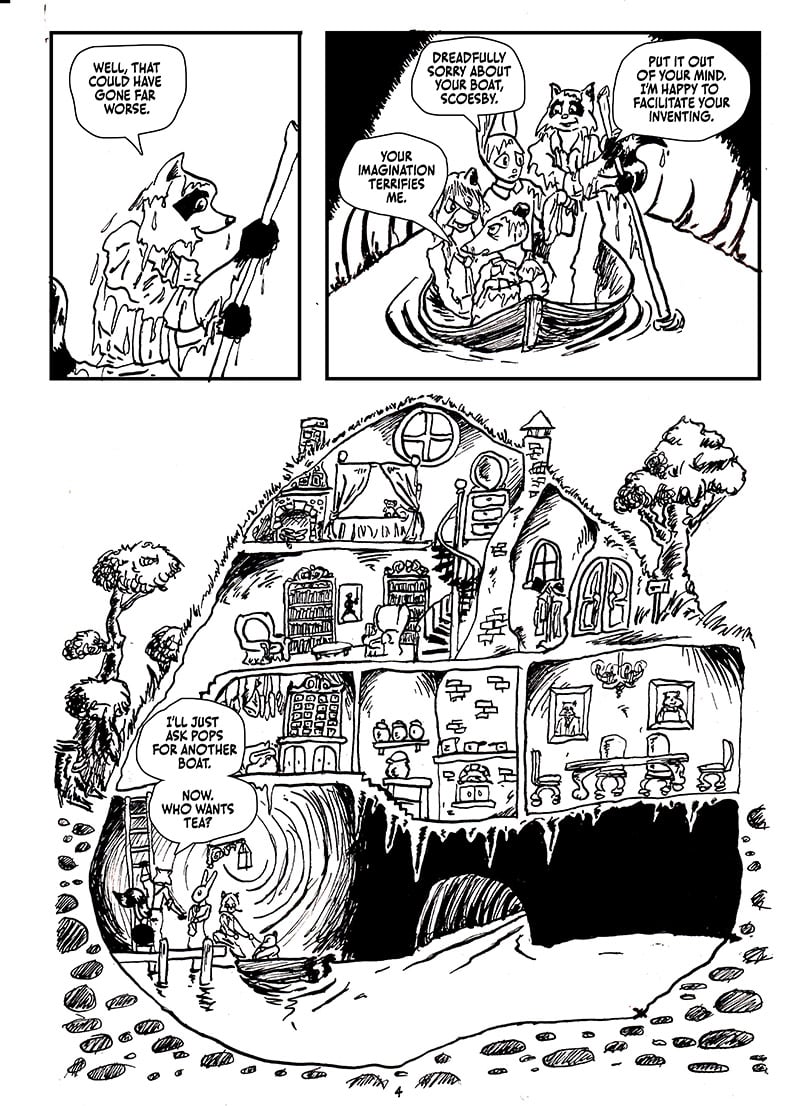
Speaking of moving forward, you may have noticed there was no newsletter last week, which means you get 2 pages of Scoesby Cuts a Rug this week. Enjoy pages 5 and 6 with my compliments. In a sort of happy accident, I do together as a peice. Page 7 is already on the Patreon.
Short newsletter this week, as I am hard a work scribbling away at things I cannot talk about. I would like to tell you, because I am very excited about these things, but I must keep quiet for now. Take comfort in the facts that there will be more things written by me that you can read in the future and that in time all will be revealed.
I know. It’s obnoxious for me, too.
But! There is a new page of Scoesby Cuts a Rug, with my love of Jill Barklem’s Brambly Hedge books on full display, no less. So that’s nice. Page 5 is already up on the Patreon.
It’s been a plague house at the Axelrod homestead this past week, with us all passing around some sort of horrible illness that left us listless and sprawled out on what ever furniture would hold us. I got it first, which meant I got to watch CABARET (1972) by my lonesome as everyone else went off to work and school, and had more or less recovered and was taking care of my wife and daughter by the time they succumbed and we all watched THE SOUND OF MUSIC (1965) as a family. I had not planned to watch musicals based on real people where the rise of Fascism in Europe provides the backdrop, but it did work out that way.
CABARET and THE SOUND OF MUSIC are, of course, very different movies made from very different musicals. THE SOUND OF MUSIC is the last of the Rogers & Hammerstein bangers, having effectively redefined the medium years earlier with OKLAHOMA!. CABARET was an experiment in form and style from the jump, an new attempt at storytelling with the combination of the cabaret review and the larger story told off. The films echo this; Robert Wise, fresh directing WEST SIDE STORY (1961), gives everything a bright Technicolor sheen, while Bob Fosse is already knee-deep in the grimy “realism” aesthetic that would come to dominate films of the 70s. Half the fun of watching the Van Trapp family is only the beautiful mountain scenery but also the spectacle of their impressive wealth. Sally Bowles and Co, however, slowly circle the drain of increasing pennilessness.
In CABERET, the singing is co-opted by the state; a opening number that celebrates the international origins of the Kit-Kat Club’s performers gives way to a dance where the performers are in sexy lederhosen and blond wigs, which then leads to explicitly Semitic comedy song. A blond Nazi boy sings “Tomorrow Belongs To Me” in a sun-drenched beer garden, and the whole crowd joins in. THE SOUND OF MUSIC proclaims that music can pull us together; CABARET is there to remind us it can also drive us apart.
Interestingly enough, both films end with one of the leads singing in front of a audience of Nazis. For Captain Von Trapp, its one last attempt of defiance before leaving the country. For Sally, it’s a defiance of different—a bellow of denial to the horrors of the outside world despite the fact that the final shot of the film shows that the Fascism of the outside world has entered the formerly comforting escapism of the cabaret. The difference is that while Sally is singing for Nazis, Von Trapp is singing at them, turning his song into a weapon that is picked up by people in the audience. It’s fitting, given its title, that THE SOUND OF MUSIC rejoices in the power of singing, how it can bring people together even when your country has been annexed by Nazis. The power is in the collective sound, the voices raised, the audience of Austrians proud of their homeland. It is a reclaiming of space, not as visually direct as when Von Trapp ripped a Nazi flag in half, but it has the same effect. Sally Bowles is singing for Nazis, while Captain Von Trapp is singing at them. The difference is dramatic.
Entertainment is not the same as resistance. But, in the right context, it can rhyme.
I rewatched the 1989 BATMAN film over the weekend. I have seen it countless times, starting when I was child, in the theater. It’s been a film that’s always loomed large in popular culture, though it’s influence has been rapidly receding as new superhero films—and new Batman films—take over the public’s imagination. I watched AVENGERS (2012) a few days prior, and the vast gulf between the two films cannot be overstated. Whatever your opinion about the two directors may be, one thing that is undeniable is that they have very different focuses. As a director, Whedon has shown he is primarily concerned with story, while Burton has made a career on visuals. Which is why AVENGERS is an enjoyable action movie that competently juggles a large cast and a memorable villain, and BATMAN is a work of art.
It’s also about art, and being an artist, which is a wild thing for a genre known for men in spandex punching each other, but we’ll get to that in a moment.
Tim Burton was, by all accounts, not a comic fan. He loved Alan Moore and Brian Bolland’s THE KILLING JOKE, though. You can see that influence in the film’s themes of obsession and depression, and the way Burton stages the Joker’s origin. But Burton, production designer Anton Furst, and cinematographer Roger Pratt were not interested in recreating the comics. Instead, they built something unique and purposeful, where every shot was artfully composed and every moment meant something. Nowhere is this more clear than in the scene mid-film in the Flugenheim art museum.
The Flugenheim Art Museum
Vicki Vale (Kim Bassinger) goes to the Flugenheim art museum ostensibly for a date with Bruce Wayne (Micheal Keaton) but, unbeknownst to her, has actually been set up by the Joker (Jack Nicholson). Earlier in the movie the people talk about cash-strapped the once-great city of Gotham is, and we see that reflected in the museum set. The museum is huge, as all the buildings in Furst’s Gotham are, making the people who walk in them small and vulnerable-looking. Vikki herself is dwarfed by the gargantuan industrial vents that dominate the entrance (another hallmark of Furst’s Gotham, where every building is part of an even larger machine). The art in this vast space is sparse and indifferently collected. An ancient Egyptian bust is displayed with a Degas painting. No theme or commonality appears to be on display. Instead, the whole group feels like the remains of several larger exhibits, that were then sold off, piece by piece, until this is that’s left in a museum too big for the scarce amount it contains. Not that it matters, because there’s barely anyone looking at the art. Most of the people here are at the museum’s restaurant, where Vicki is shown to a table.
Time is nebulous in BATMAN. Much the same way the art in the Flugenheim spans several eras at once, Gothamites walk around in 1940s and 1980s fashion, watch newscasts filmed with 1960s televesion cameras, while gangsters use tommy guns, modern machine guns, and most inexplicably, swords. It’s always night except when it’s blindingly day. Batman is presumably early in his career as a vigilante at the start of the film, still an urban legend to petty crooks. But both Bruce and Alfred have a long-campaign weariness about them, as if this war on crime has been going on for decades. So, too, is it unclear how long Vikki is left to wait in the museum’s restaurant. We only know that she’s been there awhile, and she’s irritated about it.
Vicki receives a air filter mask from an unknown admirer—but we know it’s the Joker, for who else writes a flirty card with crayon—and puts it on just as those giant industrial vents we saw at the beginning of the scene start leaking acid-green toxic gas. Everyone in the museum except Vicki dies, punishment for enjoying the food in the Flugenheim, rather than the art. The Joker enters, goons in tow, and proceeds to “improve” the art to a fantastic diegetic Prince song. At one moment, the Joker mimics a Degas ballerina sculpture, mockingly pantomiming a flying position while standing on one leg. It’s a clever touch of foreshadowing—he’ll be in similar position at the end of the movie, as a batwinged gargoyle brings that leg down from a helicopter, the Joker’s arms once again flapping to no avail.
Vicki is an artist—a photographer—and she brings her portfolio to the museum. The Joker positions himself as an artist, but it’s a lie to flatter himself. His main mediums appear to be collage and, well, murder. He doesn’t create, he destroys and calls it creation. He’s disfigured his model girlfriend’s face with acid, and tries to do the same to Vicki. He decides what is beautiful and what needs “improving.” Far from being an artist, the Joker is, in fact, the artist’s worst enemy: the critic.
The only art the Joker keeps his goons from defacing is Francis Bacon’s painting Figure with Meat, a painting who’s central figure is staring out in horror at the viewer. Before his transformation, Jack Napier chafed at not being recognized, not being seen. Now as the Joker, the only art he likes is the art that looks back, that puts the attention back on him.
He just loves being a focal point.
But what of Batman? Bruce is presented as not an artist, but he is a appreciator of fine art. An earlier scene at Wayne Manor showcases not only that Wayne has a larger art collection than the Flugenheim, but that he’s knowledgeable, already knowing about Vicki’s work before he meets her. Bruce, it turns out, is a more dedicated artist than anyone imagines. Bruce dons a new sculptured face and body and crashes through the skylight (classic move) into the museum. He is an artist who has turned himself into an artwork, who has wrapped his black cloak of misery around himself and turned it into an armor. Wearing his depression on his sleeve, Batman cannot be harmed by the Joker or his criticisms. Batman enters literally above the Joker, and when he lands it is only to take to the air again, Vicki in his arms, suspended by a Bat-rope.
The Joker’s envy of Batman reaches his peak in the museum, as he beholds a man who has transformed himself into a walking work of art. The Joker is rendered uncharacteristically silent by Batman’s appearance, only spitting out a jealous “Where does he get those wonderful toys?” as Batman swings out of the museum and on to the street. The unspoken answer is that he made them, just as they in turn make him. Those wonderful toys define Batman, the art defining the artist.
In Tim Burton’s BATMAN, the artist is the hero, having made himself one with his art. His greatest villain is a critic, his greatest love a fellow artist, and his father figure indulgent but ultimately does not understand what this whole art thing is about. Every frame is lovingly composed and shot, the light perfect, the sets heavy and physical. In order to make a Batman movie, Burton had to make Batman into a character he understood, a man weighed down by obsession and depression, but nonetheless uses his skills to fly. Preferably in a plane shaped like a bat.
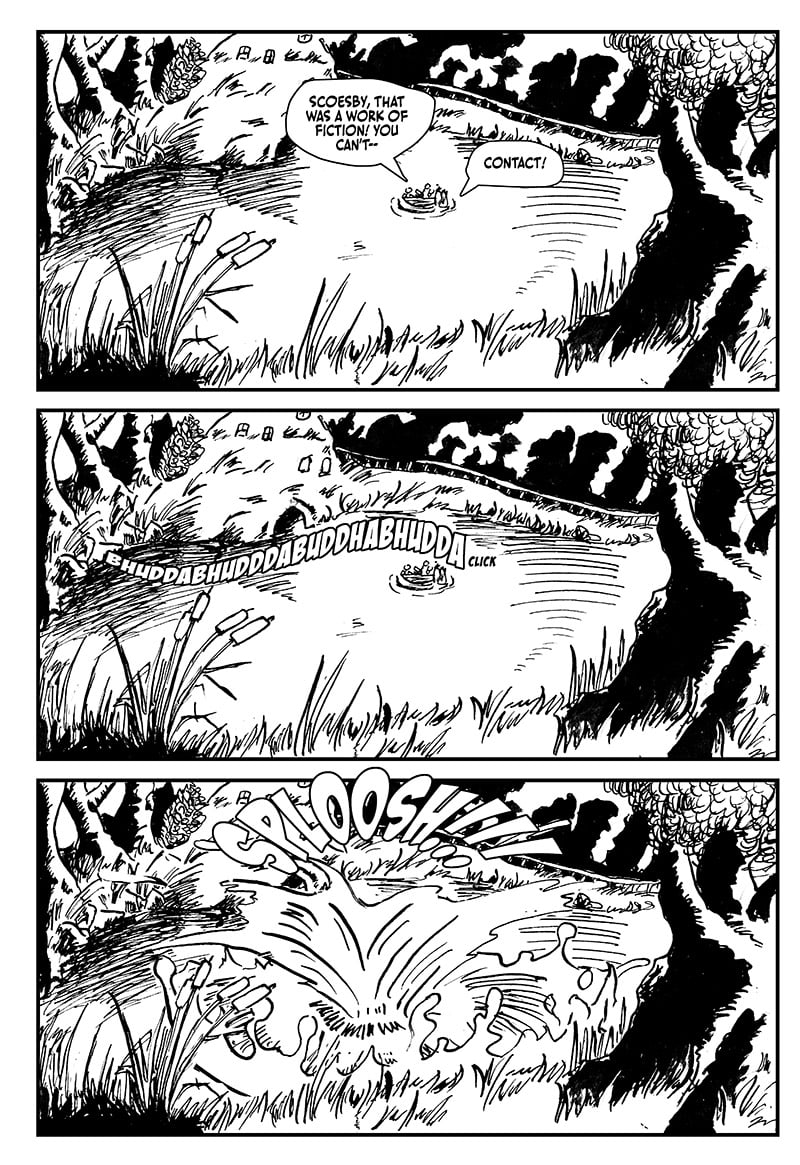
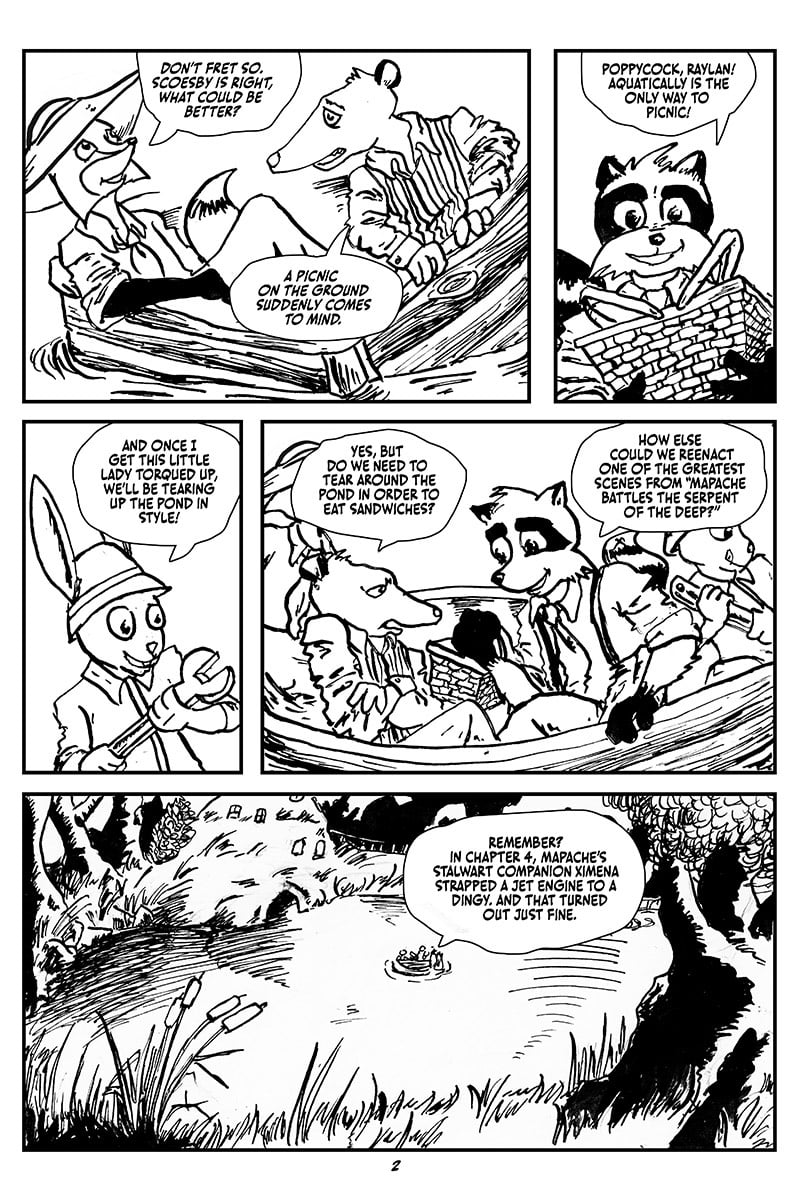
Moving on to something lighter, here’s page 2 of Scoesby Cuts A Rug, which I wrote and drew. It explains why our motley crew are in a boat with a giant engine attached. Page 3 is already on the Patreon, if you wanted to see it there.