It’s been a plague house at the Axelrod homestead this past week, with us all passing around some sort of horrible illness that left us listless and sprawled out on what ever furniture would hold us. I got it first, which meant I got to watch CABARET (1972) by my lonesome as everyone else went off to work and school, and had more or less recovered and was taking care of my wife and daughter by the time they succumbed and we all watched THE SOUND OF MUSIC (1965) as a family. I had not planned to watch musicals based on real people where the rise of Fascism in Europe provides the backdrop, but it did work out that way.
CABARET and THE SOUND OF MUSIC are, of course, very different movies made from very different musicals. THE SOUND OF MUSIC is the last of the Rogers & Hammerstein bangers, having effectively redefined the medium years earlier with OKLAHOMA!. CABARET was an experiment in form and style from the jump, an new attempt at storytelling with the combination of the cabaret review and the larger story told off. The films echo this; Robert Wise, fresh directing WEST SIDE STORY (1961), gives everything a bright Technicolor sheen, while Bob Fosse is already knee-deep in the grimy “realism” aesthetic that would come to dominate films of the 70s. Half the fun of watching the Van Trapp family is only the beautiful mountain scenery but also the spectacle of their impressive wealth. Sally Bowles and Co, however, slowly circle the drain of increasing pennilessness.
In CABERET, the singing is co-opted by the state; a opening number that celebrates the international origins of the Kit-Kat Club’s performers gives way to a dance where the performers are in sexy lederhosen and blond wigs, which then leads to explicitly Semitic comedy song. A blond Nazi boy sings “Tomorrow Belongs To Me” in a sun-drenched beer garden, and the whole crowd joins in. THE SOUND OF MUSIC proclaims that music can pull us together; CABARET is there to remind us it can also drive us apart.
Interestingly enough, both films end with one of the leads singing in front of a audience of Nazis. For Captain Von Trapp, its one last attempt of defiance before leaving the country. For Sally, it’s a defiance of different—a bellow of denial to the horrors of the outside world despite the fact that the final shot of the film shows that the Fascism of the outside world has entered the formerly comforting escapism of the cabaret. The difference is that while Sally is singing for Nazis, Von Trapp is singing at them, turning his song into a weapon that is picked up by people in the audience. It’s fitting, given its title, that THE SOUND OF MUSIC rejoices in the power of singing, how it can bring people together even when your country has been annexed by Nazis. The power is in the collective sound, the voices raised, the audience of Austrians proud of their homeland. It is a reclaiming of space, not as visually direct as when Von Trapp ripped a Nazi flag in half, but it has the same effect. Sally Bowles is singing for Nazis, while Captain Von Trapp is singing at them. The difference is dramatic.
Entertainment is not the same as resistance. But, in the right context, it can rhyme.
I rewatched the 1989 BATMAN film over the weekend. I have seen it countless times, starting when I was child, in the theater. It’s been a film that’s always loomed large in popular culture, though it’s influence has been rapidly receding as new superhero films—and new Batman films—take over the public’s imagination. I watched AVENGERS (2012) a few days prior, and the vast gulf between the two films cannot be overstated. Whatever your opinion about the two directors may be, one thing that is undeniable is that they have very different focuses. As a director, Whedon has shown he is primarily concerned with story, while Burton has made a career on visuals. Which is why AVENGERS is an enjoyable action movie that competently juggles a large cast and a memorable villain, and BATMAN is a work of art.
It’s also about art, and being an artist, which is a wild thing for a genre known for men in spandex punching each other, but we’ll get to that in a moment.
Tim Burton was, by all accounts, not a comic fan. He loved Alan Moore and Brian Bolland’s THE KILLING JOKE, though. You can see that influence in the film’s themes of obsession and depression, and the way Burton stages the Joker’s origin. But Burton, production designer Anton Furst, and cinematographer Roger Pratt were not interested in recreating the comics. Instead, they built something unique and purposeful, where every shot was artfully composed and every moment meant something. Nowhere is this more clear than in the scene mid-film in the Flugenheim art museum.
The Flugenheim Art Museum
Vicki Vale (Kim Bassinger) goes to the Flugenheim art museum ostensibly for a date with Bruce Wayne (Micheal Keaton) but, unbeknownst to her, has actually been set up by the Joker (Jack Nicholson). Earlier in the movie the people talk about cash-strapped the once-great city of Gotham is, and we see that reflected in the museum set. The museum is huge, as all the buildings in Furst’s Gotham are, making the people who walk in them small and vulnerable-looking. Vikki herself is dwarfed by the gargantuan industrial vents that dominate the entrance (another hallmark of Furst’s Gotham, where every building is part of an even larger machine). The art in this vast space is sparse and indifferently collected. An ancient Egyptian bust is displayed with a Degas painting. No theme or commonality appears to be on display. Instead, the whole group feels like the remains of several larger exhibits, that were then sold off, piece by piece, until this is that’s left in a museum too big for the scarce amount it contains. Not that it matters, because there’s barely anyone looking at the art. Most of the people here are at the museum’s restaurant, where Vicki is shown to a table.
Time is nebulous in BATMAN. Much the same way the art in the Flugenheim spans several eras at once, Gothamites walk around in 1940s and 1980s fashion, watch newscasts filmed with 1960s televesion cameras, while gangsters use tommy guns, modern machine guns, and most inexplicably, swords. It’s always night except when it’s blindingly day. Batman is presumably early in his career as a vigilante at the start of the film, still an urban legend to petty crooks. But both Bruce and Alfred have a long-campaign weariness about them, as if this war on crime has been going on for decades. So, too, is it unclear how long Vikki is left to wait in the museum’s restaurant. We only know that she’s been there awhile, and she’s irritated about it.
Vicki receives a air filter mask from an unknown admirer—but we know it’s the Joker, for who else writes a flirty card with crayon—and puts it on just as those giant industrial vents we saw at the beginning of the scene start leaking acid-green toxic gas. Everyone in the museum except Vicki dies, punishment for enjoying the food in the Flugenheim, rather than the art. The Joker enters, goons in tow, and proceeds to “improve” the art to a fantastic diegetic Prince song. At one moment, the Joker mimics a Degas ballerina sculpture, mockingly pantomiming a flying position while standing on one leg. It’s a clever touch of foreshadowing—he’ll be in similar position at the end of the movie, as a batwinged gargoyle brings that leg down from a helicopter, the Joker’s arms once again flapping to no avail.
Vicki is an artist—a photographer—and she brings her portfolio to the museum. The Joker positions himself as an artist, but it’s a lie to flatter himself. His main mediums appear to be collage and, well, murder. He doesn’t create, he destroys and calls it creation. He’s disfigured his model girlfriend’s face with acid, and tries to do the same to Vicki. He decides what is beautiful and what needs “improving.” Far from being an artist, the Joker is, in fact, the artist’s worst enemy: the critic.
The only art the Joker keeps his goons from defacing is Francis Bacon’s painting Figure with Meat, a painting who’s central figure is staring out in horror at the viewer. Before his transformation, Jack Napier chafed at not being recognized, not being seen. Now as the Joker, the only art he likes is the art that looks back, that puts the attention back on him.
He just loves being a focal point.
But what of Batman? Bruce is presented as not an artist, but he is a appreciator of fine art. An earlier scene at Wayne Manor showcases not only that Wayne has a larger art collection than the Flugenheim, but that he’s knowledgeable, already knowing about Vicki’s work before he meets her. Bruce, it turns out, is a more dedicated artist than anyone imagines. Bruce dons a new sculptured face and body and crashes through the skylight (classic move) into the museum. He is an artist who has turned himself into an artwork, who has wrapped his black cloak of misery around himself and turned it into an armor. Wearing his depression on his sleeve, Batman cannot be harmed by the Joker or his criticisms. Batman enters literally above the Joker, and when he lands it is only to take to the air again, Vicki in his arms, suspended by a Bat-rope.
The Joker’s envy of Batman reaches his peak in the museum, as he beholds a man who has transformed himself into a walking work of art. The Joker is rendered uncharacteristically silent by Batman’s appearance, only spitting out a jealous “Where does he get those wonderful toys?” as Batman swings out of the museum and on to the street. The unspoken answer is that he made them, just as they in turn make him. Those wonderful toys define Batman, the art defining the artist.
In Tim Burton’s BATMAN, the artist is the hero, having made himself one with his art. His greatest villain is a critic, his greatest love a fellow artist, and his father figure indulgent but ultimately does not understand what this whole art thing is about. Every frame is lovingly composed and shot, the light perfect, the sets heavy and physical. In order to make a Batman movie, Burton had to make Batman into a character he understood, a man weighed down by obsession and depression, but nonetheless uses his skills to fly. Preferably in a plane shaped like a bat.
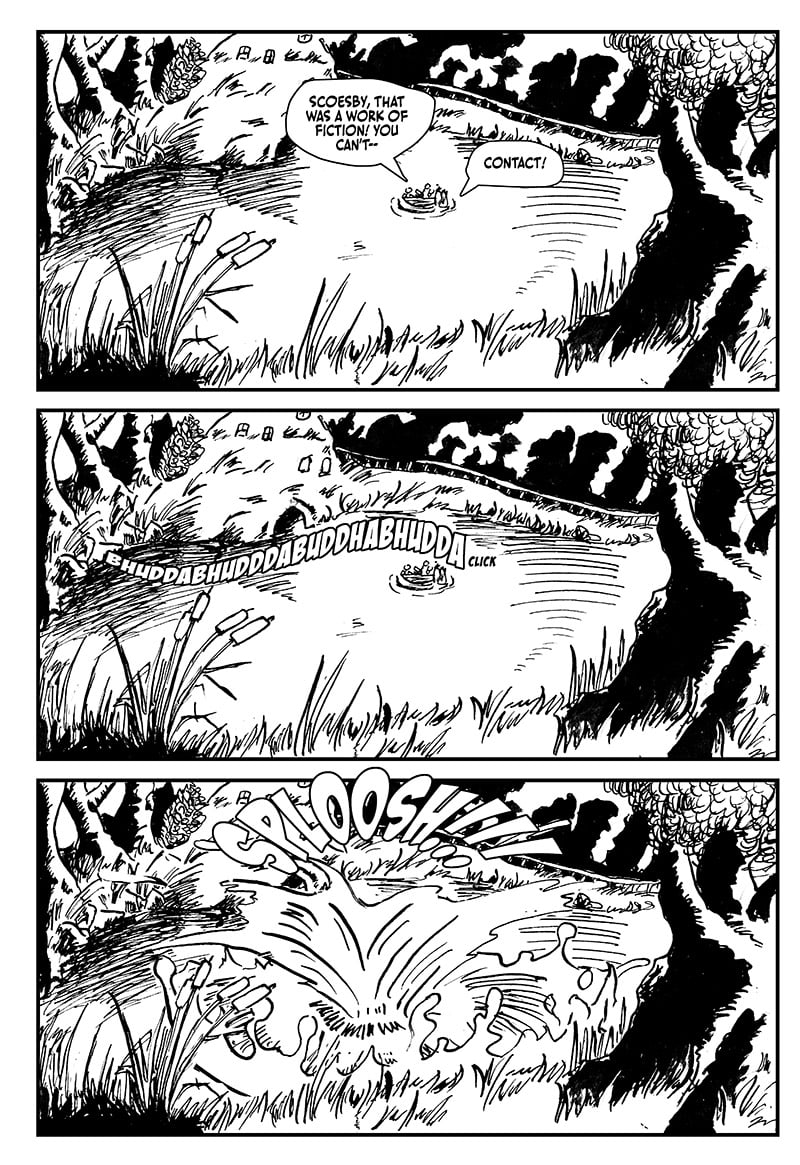
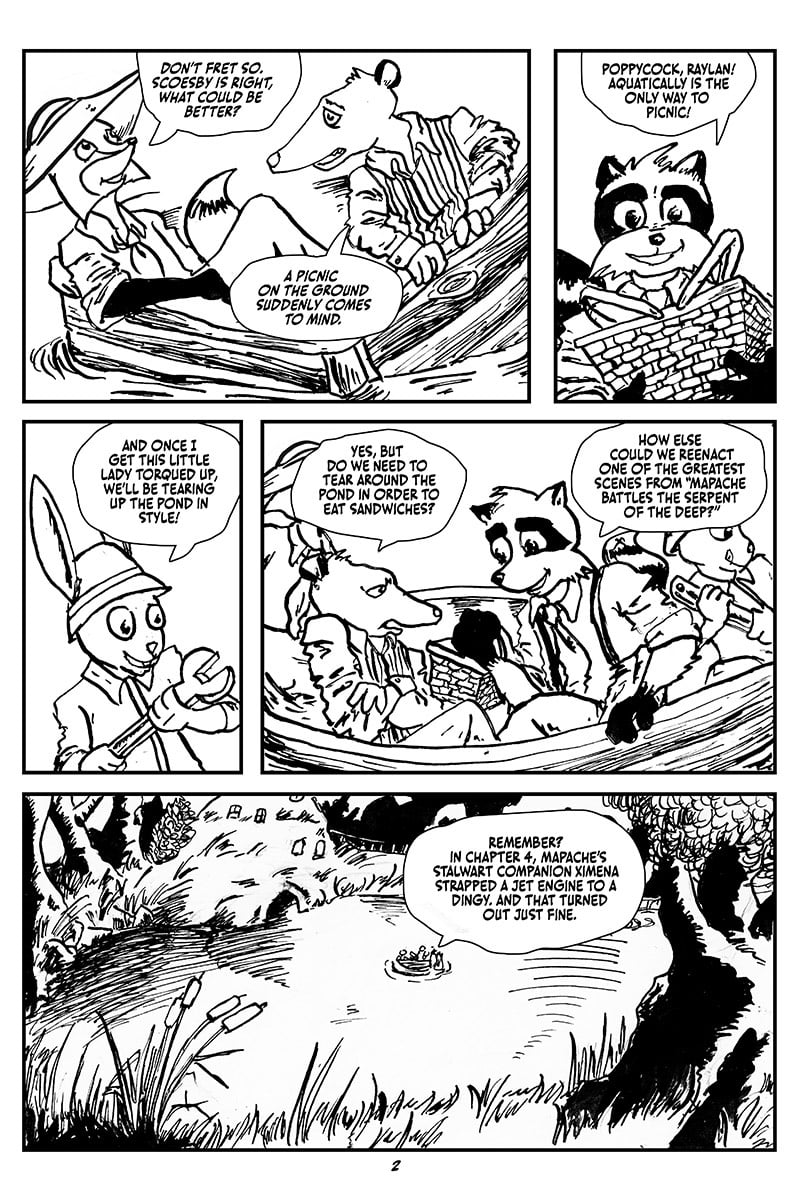
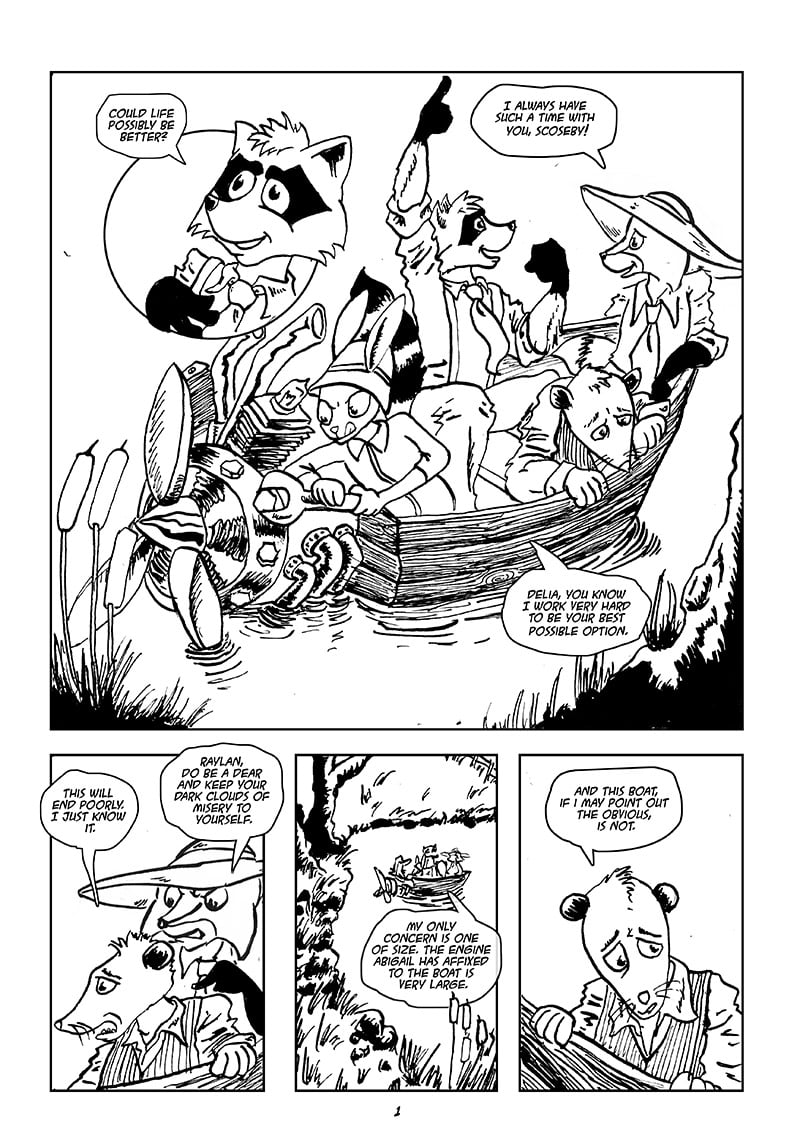
Moving on to something lighter, here’s page 2 of Scoesby Cuts A Rug, which I wrote and drew. It explains why our motley crew are in a boat with a giant engine attached. Page 3 is already on the Patreon, if you wanted to see it there.
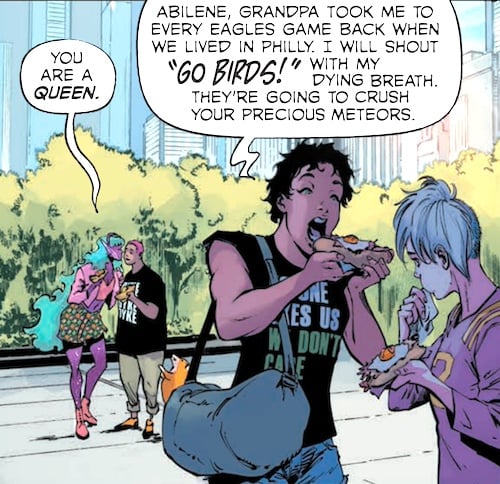
The Eagles won the Super Bowl, which is great for everyone living in Philly. There is a type of mania that envelopes the city when one of our teams gets close to a championship. It stops being about sports entirely, and is instead a city-wide celebration of communal excitement. Maybe that’s why we say “Go birds” instead of “Go Eagles;” its no longer about the Eagles. Its about all of us, all the birds in city. And then to toss a colossal win on top of that? That’s a party no barricade can hold back. You cannot contain all the the birds in the city. You just have to let them fly.
Hawkgirl knows this. I’m certain she was celebrating on the Justice League Watchtower Sunday night.
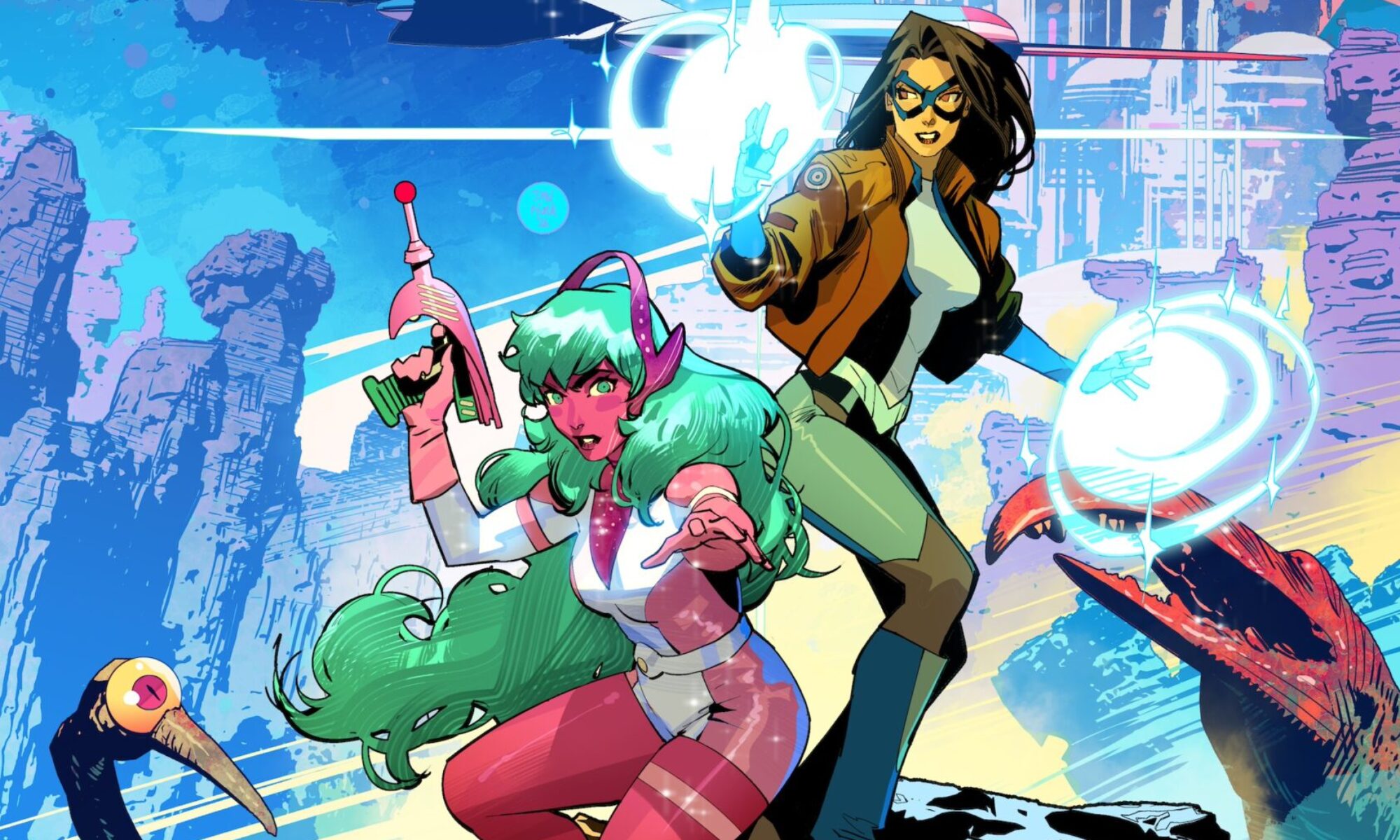
This is your reminder to pick up Hawkgirl: Once Upon A Galaxy
Last week on the Patreon I started Scoesby Cuts a Rug, a comic I began over a decade ago and am now, finally, finishing. Or will be finishing, in a couple of months when we hit the end of its 36 pages.
Scoesby Cuts a Rug is about a well-to-do raccoon named Scoesby who can’t quite get his life together. In tone, it sits somewhere between Walt Kelly and P.G. Wodehouse, as Scoesby is beset upon by the often conflicting demands of friends and family in the midst of idyllic Southern environs, trying to figure out what he wants and why he isn’t satisfied just being himself.
The old me could not figure out a reason for Scoesby’s internal struggle, but it was no problem for my current self to see the trans metaphor in this poor raccoon’s quandaries. At the risk of giving away (part of) the ending, Scoesby turns out to be a trans girl. I know, you’re all shocked. But sometimes we write stories we’re not even aware we’re writing. It isn’t until we read them back years later that we finally have the words we knew were missing but couldn’t find.
It’s interesting, continuing a piece of art long…abandoned isn’t the proper word. Set aside, perhaps, to be fished out of drawers and files, to be looked upon and inspected and imagined what might be done or might have been, if I had the time now or if I had made the time to continue what I had started. In the end, the result is a conversation with the me who started this story, who was so confident on how it should begin, but could never quite place how it should end. He couldn’t do that. And so it falls to me.
I had to have emergency gastrointestinal surgery back in September, and had to switch to a vegan diet during recovery. I’ve decided to stay vegan, and have been enjoying learning new ways to cook and eat. I don’t miss meat and dairy as much as I thought I would. My doctor is very pleased.
One thing that gets me about eating vegan, though, is how it’s almost impossible to feel satisfied. The emotional quality of satisfaction of a meal well-dined. As someone who has spent a lifetime overeating, chasing that feeling of chemically-triggered happiness long after my stomach was full, this good thing. I need not lean on my dinner plate for mood regulation. I can’t be satisfied after eating vegan food, but I can not be hungry anymore. And isn’t that the most important thing?
It’s like being trans, in a way.
There is a hunger to being trans. To being given a body that, for whatever reason, doesn’t click with who you are. A primal desire with you for something that you need, you don’t why, you just need it. Not having it makes you sadder than anything else in the world, weighted down by a need you can’t explain. Once you name it, and take your first steps toward aligning your body with your head and your heart, the euphoria is immense. Like eating a banquet after starving for your entire life.
I am no longer hungry when I look in the mirror. I’ve been at this for nearly a decade, and it feels right in a way that nothing did before I started. HRT has been good to me, giving me a body and a face that feels more correct, more accurate to who I am. I’m not hungry, but I’m also not satisfied.
I might be, one day. Surgery can do miracles, as some of my trans friends can attest to. I don’t know if they’re satisfied, though. Maybe none of us can be. Maybe no one is.
When I was a child, I would eat until I was physically uncomfortable, desperately savoring the endorphins that came with each mouthful fully aware they would dissipate with each swallow. I was so hungry then. No amount of food could sate me. Because it wasn’t food I was hungry for.
I’m not hungry anymore. Which is the important thing.
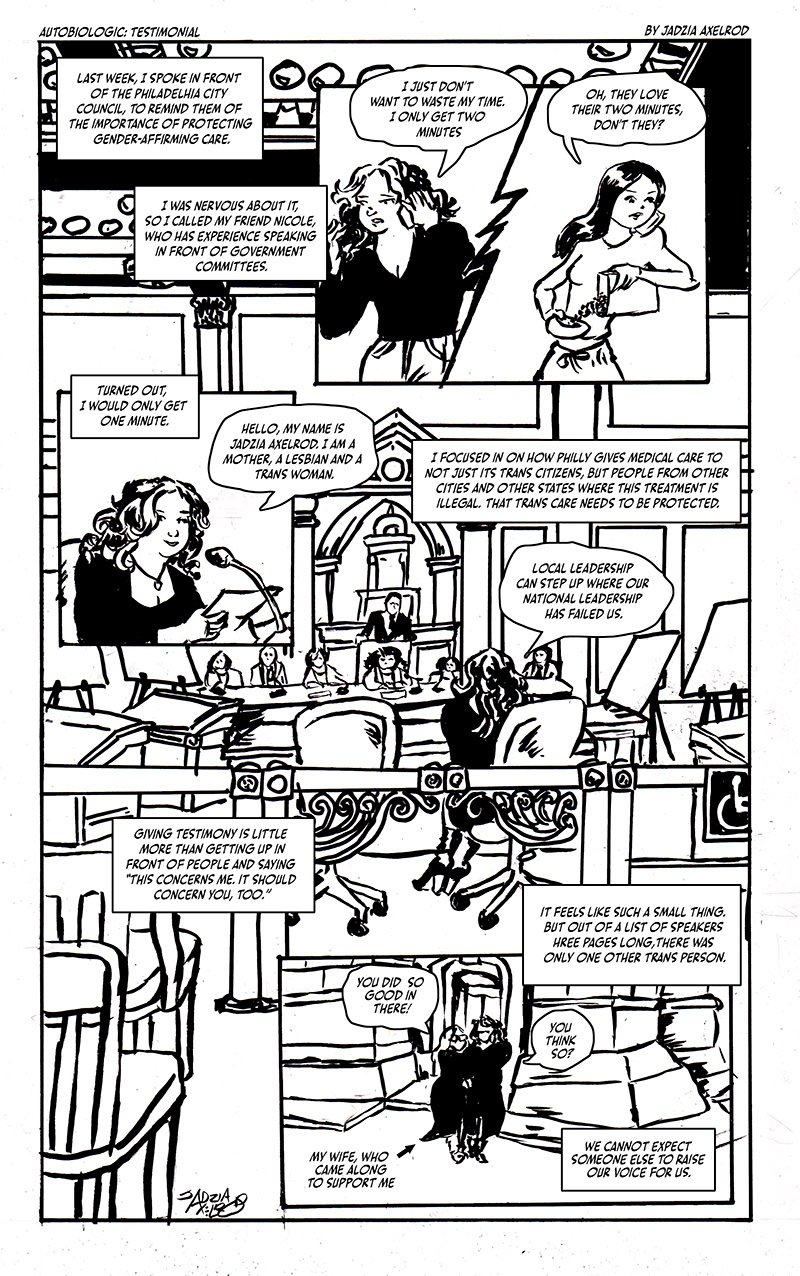
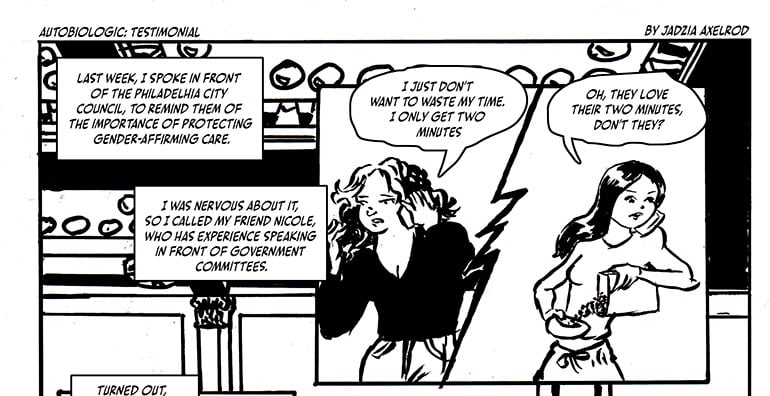
While we’re on the subject of the importance of gender-affirming care, I made a comic about my experience speaking about it in front of the Philadelphia City Council.
Autobiologic: Testimonial
I already talked about this in my last newsletter, but getting involved locally can lead to real dividends, even if just for your peace of mind.
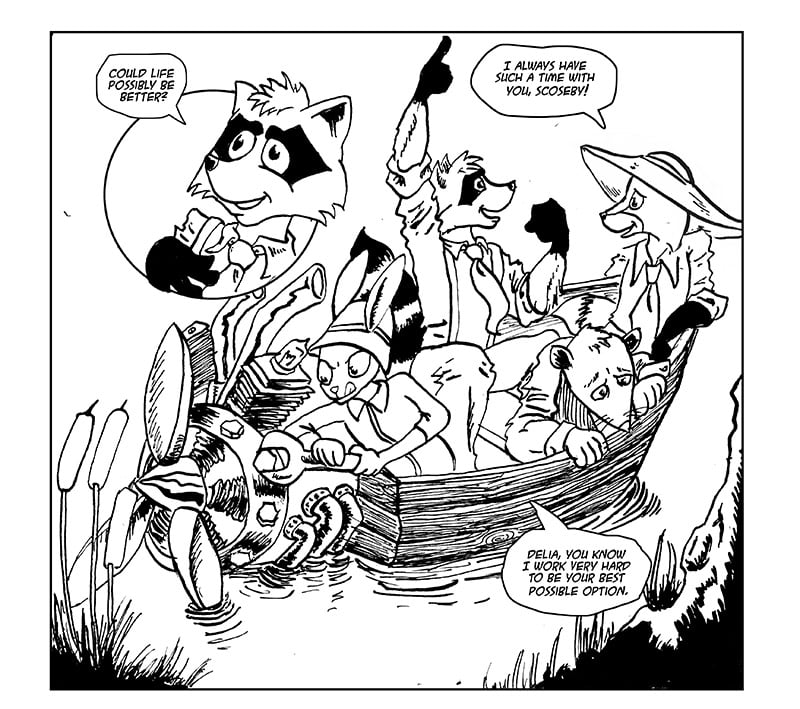
This week on the Patreon starts a 36-page story about funny animals and gender feels. It’s journey. And it starts, as so many journeys do, on a boat.
This cannot end well.
It’s a story I started years ago, and I’m excited to finally finish it. Hope you’ll come along on the ride.
Giving testimony is a strange endeavor; it’s important to alert lawmakers to your concerns, but it feels meaningless. How can I express everything I’m worried about in less than two minutes? The architecture of government buildings, designed for pomp and grandeur, can make you feel very small when you’re inside them. It can make what you have to say feel unimportant. It can make you feel unimportant.
You have to remember that you are important, that what you have to say is worth saying, and that you can and will say it with your whole chest. And to treat that time limit seriously.
If nothing else, coming to the City Council meeting reassured me about the immediate future. Things are not heading in a good direction, and I do not trust all of my elected officials. But hearing the testimony of others, especially those representing larger organizations in the city who have plans with how to deal with the recent attacks on immigration and LGBTQIA+ rights. I’m not alone in my concerns, and that knowledge was worth the trip all by itself.
I think in the coming years, it would behoove us all to get more involved in local government. And small ways like giving testimony at open sessions is great way to start.
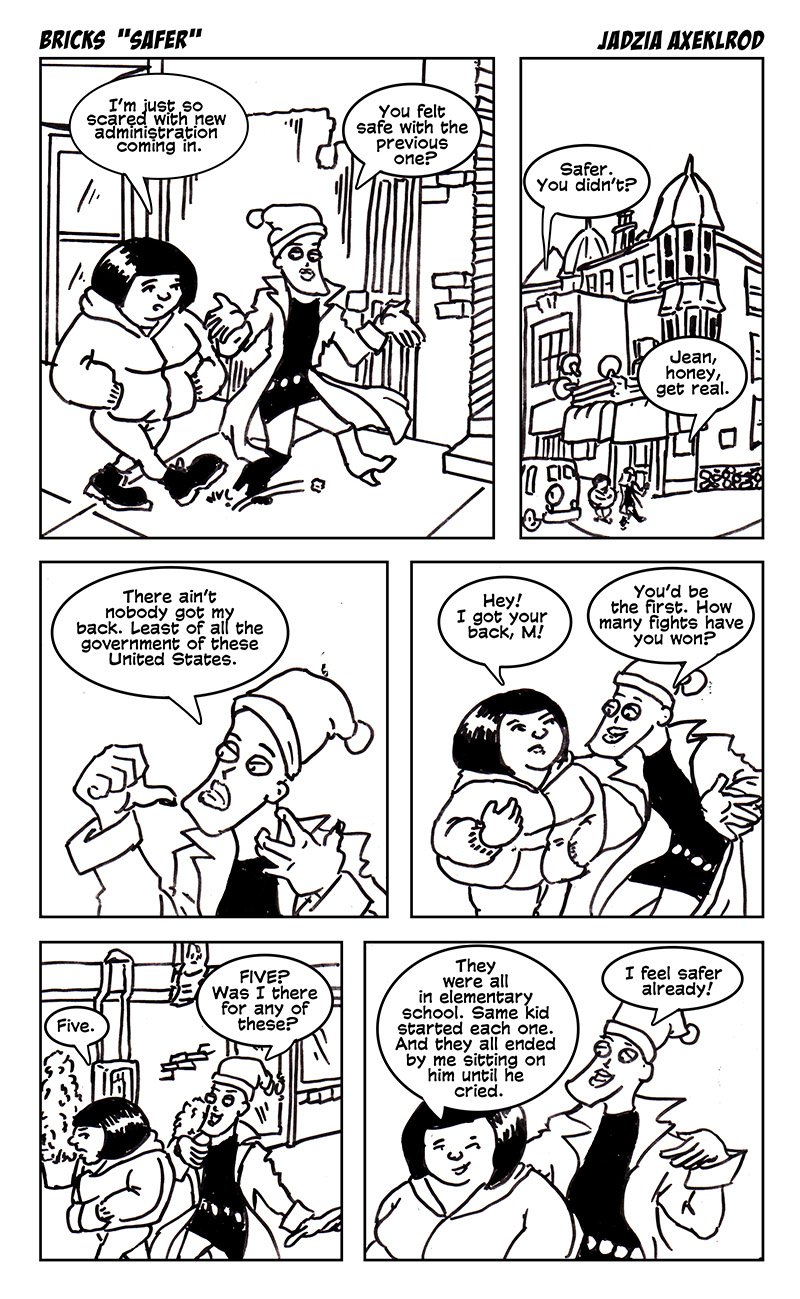
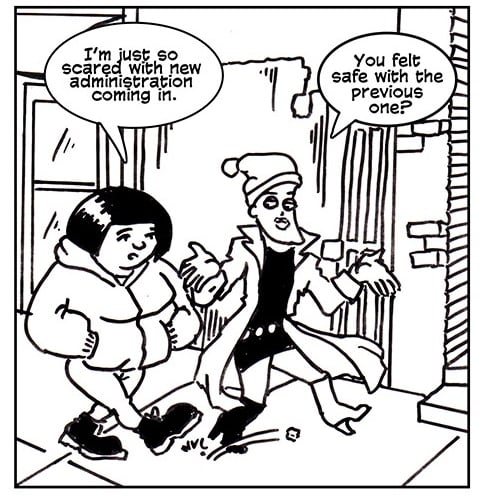
Here’s the comic for this week. BRICKS was something I’ve been tossing around for awhile now: What if DYKES TO WATCH OUT FOR but also Hergé and about trans people? I’m not sure if all jives, but I think there’s enough there that its worth developing further.
The point of fascism is to rule utterly, to perform horrors with no consequence and to deny that they are horrors at all. It is the power that comes from control, not just political control but narrative control. They define the truth is, even if what they say flies in the face of what you witnessed with your own eyes.
Now, I have studied fascism, but I cannot claim to be a political expert. I am, however, a narrative expert. I can claim that one. So believe me when I tell you that the most important things you can do to armor yourself in the coming years to remember one thing: they get off on your despair.
Gross, right? Good. These horrible little boys with old men’s faces wearing their father’s ill-fitting suits are going to try to convince us they are invincible, they are inevitable, that they are somehow than human, or at the very least more human than we are. They will get into our heads. But not if we know what sick little puppies they are, desperately jerking off to the sadness and panic they create.
I know its ridiculous, but we live in ridiculous times. And if telling myself that by not dissolving into sadness I am denying a disgusting power-grabber from getting an erection keeps me from succumbing to despair, maybe it will do the same for you.
Another thing you can do is quit Twitter, Facebook, Instagram, Whatsapp, and TikTok, as it has become quite clear that they intend to be the propaganda arm of the new regime. I’m just down to Bluesky, but I’m prepared to leave that, too, if needs must. Get the phone numbers and emails of the folks you want to stay in touch with, and delete your accounts. Keeping our minds clear is going to be hard enough as it is, without the manufactured outrage that is these services stock and trade.
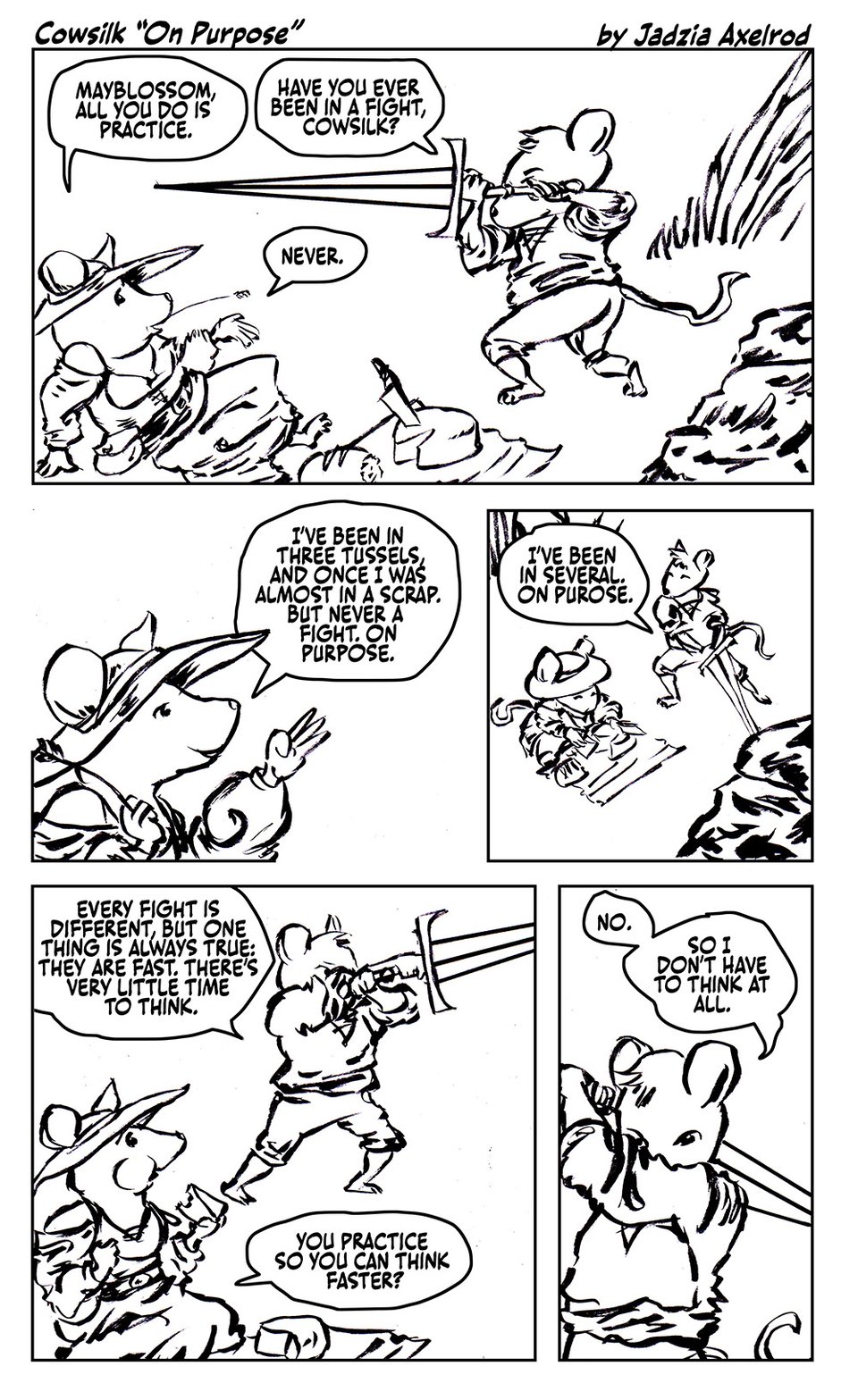
Here’s a comic about mice with swords. Seems silly to post it now, but we also need silliness in our lives.
They’re in love
I’ve been reading Brian Jacques’s REDWALL series to my daughter, and while it is just as delightful as I remember from when I read it at her age, I can’t fail to notice that the girls don’t do anything as cool as what the boys do. This is lessoned somewhat in the later books, but it’s still a boy’s world. That got me thinking about a fantasy world full of female mice who are funny and clever and others who wield swords, and what if those two of those mousemaids were in love?
So, that’s COWSILK. I haven’t thought of a larger story with Cowsilk and Mayblossom yet, but I already love these characters, so I imagine one will come to me.
Over at my Patreon, there’s something completely different, an riff on Alison Bechdel and Hergé about being a trans woman in 2025. Maybe you should check it out.
It was a year of opportunities dangled and then taken away, of projects indefinitely delayed, of working hard and ending up with very little to show for it. My body kept the score, as it always does, and I ended in up in the emergency room for organ failure. The part of me that gave up the ghost was removed—not without struggle, according to the surgeons, who had to make a bigger incision than expected. Now one organ lighter, my recovery necessitated diet free from animal products. So, we can add “meet” and “cheese” to the long list of things I lost in 2024, along with organs, jobs, etcetera.
But if I may find a silver lining to an essential part of my body ceasing to function, I think to switch to veganism has been good for me and its something I intend to continue. Painful events can sometimes lead to positive changes. So I’m going to look to 2025 with an open heart.
The following year, 2026, will see the release of my next book with DC Comics (which should be announced soon!) and I have a pretty good idea of what that year is going to look like because of it. But 2025 could be anything. It will no doubt be difficult—yesterday, the US House of Representatives voted 218-206 to ban transgender girls from girls sports in federally funded schools, so we’re not off to a great start—but perhaps it will also be rewarding. Maybe things will get better, maybe I’ll get better. Or maybe I’ll just stay the same. That would be a victory, in its way, after all the changes of the past year and the possible horrors that are lying in wait in this one.
Here’s to the new year, and the same me.
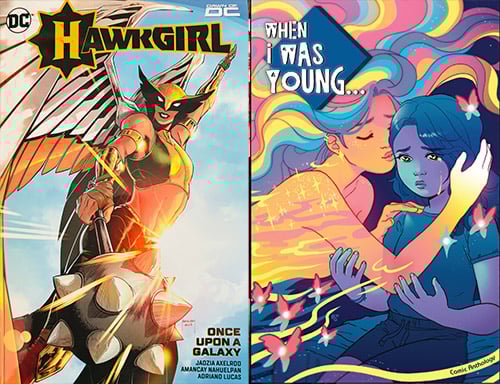
I cannot say that all of 2024 was bad. After all, it saw two publications with my name on it: HAWKGIRL-ONCE UPON A GALAXY, which collects the 2023 HAWKGIRL miniseries in one tidy volume, and “Secret Identity,” a story in the anthology WHEN I WAS YOUNG… which I wrote and drew and was colored by the remarkably talented Robin Fasel.
Drawing that story was wonderful, but it also drove home how rusty my visual art muscles are. Practice makes permanent, as my daughter’s music instructor says, so I am challenging myself to draw 50 comic pages this year. That’s not a whole lot, but last year I only did 4, so, baby steps.
I’m going to start with a few stand-alone pages, not connected to a larger story, but featuring characters I’ve been meaning to work with. These characters could go on to larger stories—after all, I’ve got 50 pages to fill—but mainly I just want to play around. I want to see what gets me excited about drawing, and do that.